

Lawn Care Equipment · Buyer’s Guide
Best Lawn Aerators: 15 Tools That Actually Loosen Compacted Soil
From tow-behind pluggers for sprawling yards to handheld hollow-tine forks and strap-on shoes, we break down the aerators worth owning — and match each one to the lawn it was made for.
Editor’s Guide
The Short List: Finding the Best Lawn Aerator for Your Yard

Compacted soil is the quiet killer of otherwise healthy lawns. Grass can be watered on schedule, fed twice a season, and mowed beautifully — and still thin out, brown at the edges, and surrender ground to moss and weeds. The reason is usually underneath the blades: soil packed so tightly that roots cannot spread, water pools and runs off, and fertilizer never reaches where it is needed. That is exactly the problem a lawn aerator solves.
The catch is that “lawn aerator” covers a huge range of tools. There are tow-behind plug aerators you drag behind a riding mower for acre-sized lawns, hollow-tine hand tools for postage-stamp yards, rolling drum machines you push like a mower, spike shoes you strap on while you walk the dog, and even liquid formulas you spray from a hose-end bottle. Picking the wrong category means buying a tool that is either comically oversized for your yard or painfully inadequate for it.
That is what this guide is for. We have rounded up fifteen of the most talked-about lawn aerators across every category — tow-behind, manual coring, stand-up spike, rolling, shoe-mounted, and liquid — and laid out what each one genuinely does well, where it falls short, and exactly who should buy it. If you are completely new to the process, our walkthrough on how to aerate a lawn covers the fundamentals before you shop.
You will find a master comparison table right below this introduction, followed by deep dives grouped by aerator type, an honest look at spike versus plug versus liquid methods, timing advice, aftercare tips, and answers to the questions homeowners ask most. Whether you maintain a quarter-acre suburban lawn or several acres of mixed turf, there is a right tool here — and plenty of wrong ones you can now confidently skip.
At a Glance
Quick Comparison: Our Top Picks
Here is every aerator in this guide side by side. Rows are ranked by how well each tool delivers results for its intended lawn size and use case, with the top pick highlighted. Product details are kept honest — where a specification is not guaranteed, we describe the capability in plain language instead of inventing numbers.
Swipe to see more →
| # | Image | Product | Key Specs | Verdict | Check Price |
|---|---|---|---|---|---|
| 1 | |
Top PickAgri-Fab 48″ Tow-Behind Plug AeratorBest for Large Lawns | Tow-behind · 48″ working width · Core/plug removal · Ride-on compatible | The wide, plug-removing workhorse for anyone with real acreage to cover. | Check Price on Amazon |
| 2 |  |
Yard Butler Manual Lawn Coring AeratorBest Manual Coring Tool | Manual · Hollow-tine coring · Foot leverage · No fuel or cords | A cult-favorite hand tool that removes real cores without a machine. | Check Price on Amazon |
| 3 |  |
Craftsman 40″ Tow-Behind Plug AeratorBest Premium Tow-Behind | Tow-behind · 40″ working width · Core removal · Ride-on compatible | A slightly narrower tow-behind from a brand with serious lawn-care pedigree. | Check Price on Amazon |
| 4 | |
Landzie Hollow Tine Fork Lawn AeratorBest Fork-Style Corer | Manual · Hollow tines · Long handle · Multi-tine layout | Simple, sturdy, and satisfying — a fork aerator built to outlive the lawn. | Check Price on Amazon |
| 5 | 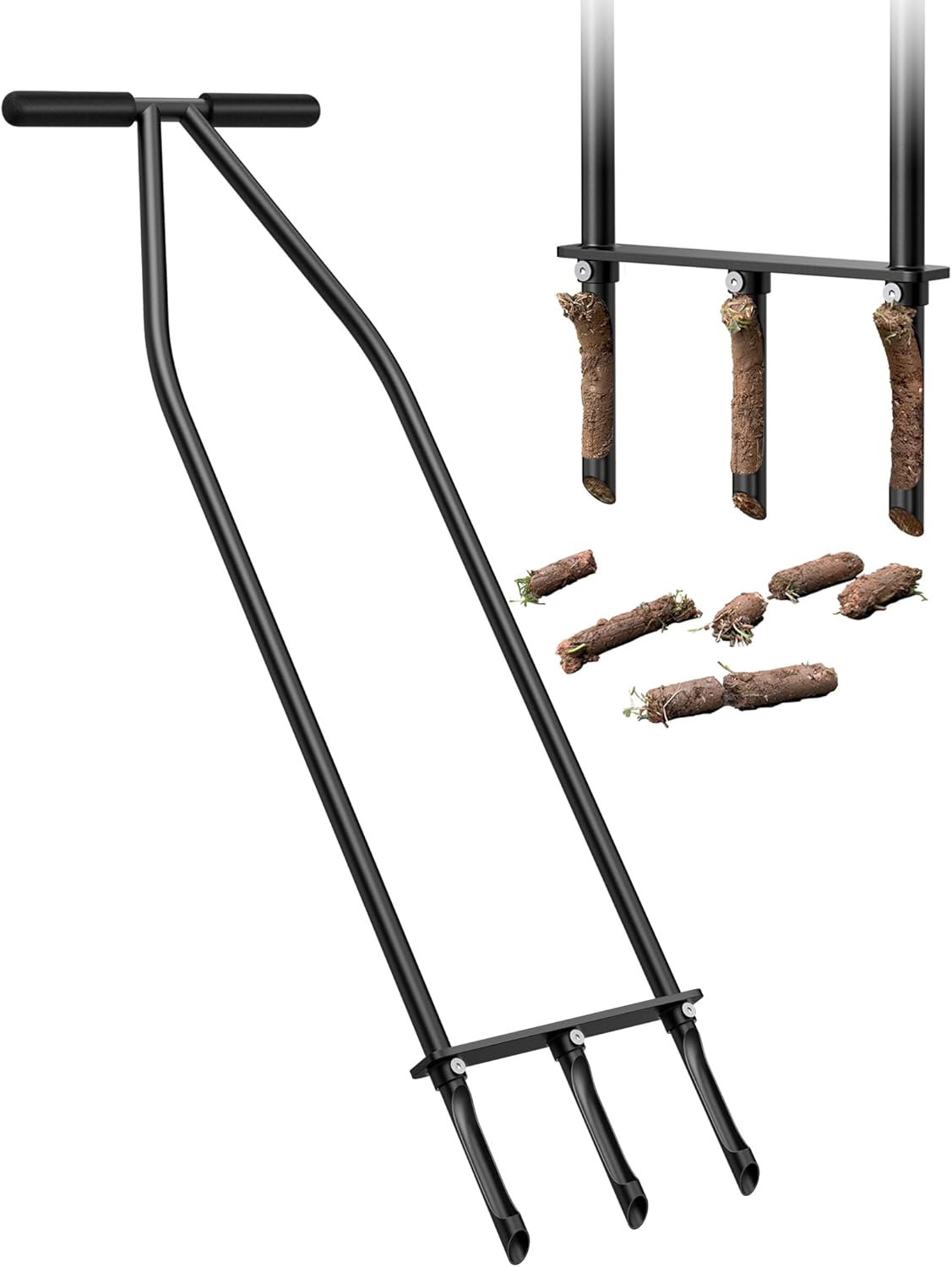 |
Xuperace Core Aerator Lawn ToolBest Budget Coring Tool | Manual · Hollow-tine core removal · Compact form · Low effort entry | Approachable and inexpensive way to try true core aeration at home. | Check Price on Amazon |
| 6 |  |
hugeneroy Heavy Duty Hollow Tine Core AeratorBest Heavy-Duty Manual | Manual · Heavy-duty hollow tines · Reinforced build · Core removal | Built for clay-heavy ground where lighter tools fold up and quit. | Check Price on Amazon |
| 7 |  |
Seeutek 40″ Tow-Behind Spike AeratorBest Tow-Behind Spike | Tow-behind · 40″ working width · Spike tines · Ride-on compatible | Fast, lightweight coverage for lawns that need loosening, not plug removal. | Check Price on Amazon |
| 8 |  |
K.D STONEDGE Rolling Lawn AeratorBest Rolling Aerator | Rolling drum · Push design · Wide pass coverage · Compact storage | A rolling approach that turns aeration into an ordinary yard walk. | Check Price on Amazon |
| 9 | 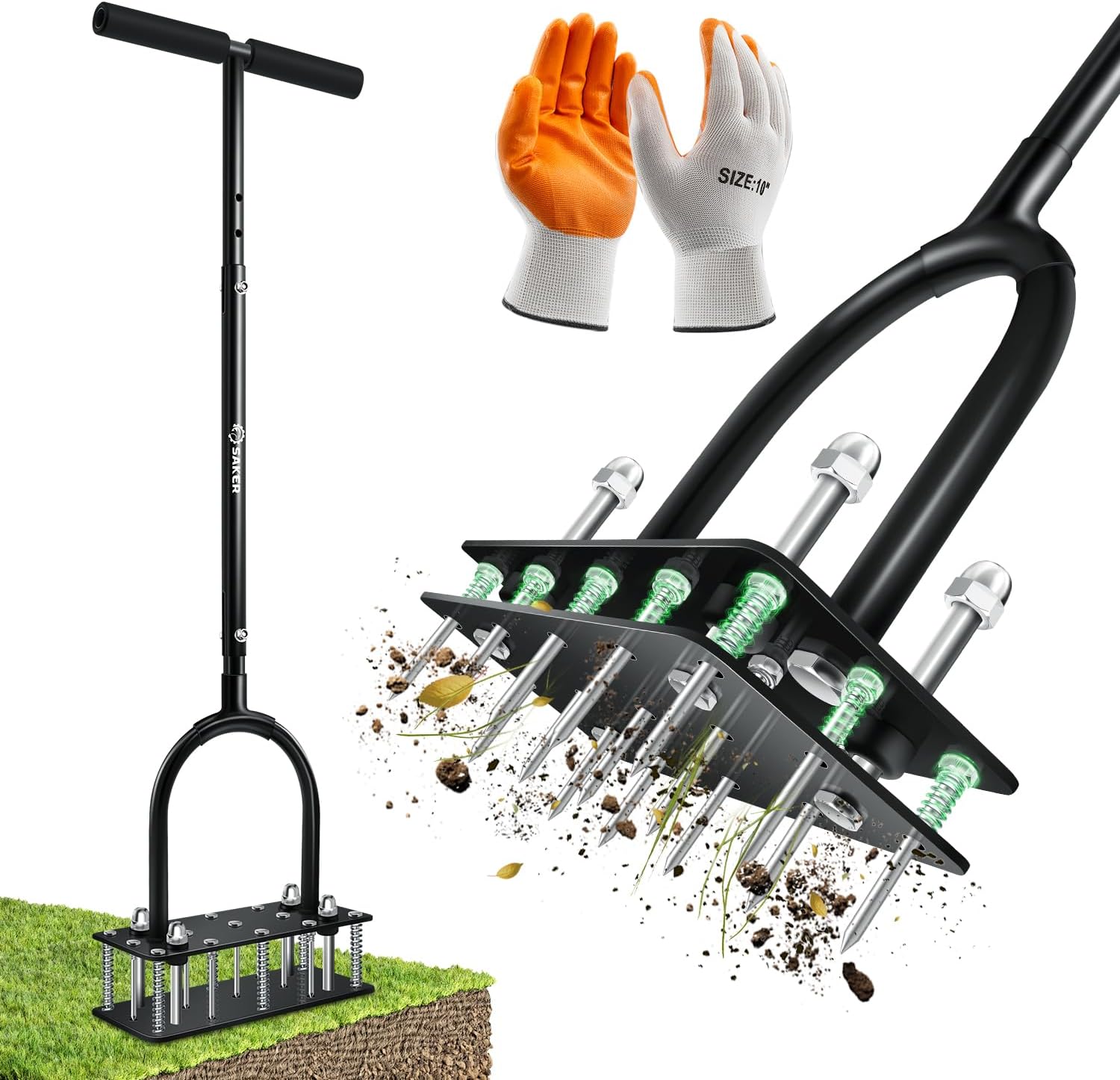 |
Saker Manual Lawn AeratorBest Stand-Up Manual | Manual · Stand-up operation · Spike/coring style · No assembly marathon | A straightforward stand-up tool for quick passes around trouble spots. | Check Price on Amazon |
| 10 |  |
Jardineer Spike Lawn AeratorBest for Small Yards | Manual · Spike tines · Lightweight · Quick spot treatment | Grab-and-go spike aeration for patios, borders, and tight lawns. | Check Price on Amazon |
| 11 |  |
Bluesea 16-Spike Lawn AeratorBest Wide-Coverage Spike | Manual · 16-spike layout · Broad single-pass coverage · Spike method | More spikes per pass means fewer passes per square foot. | Check Price on Amazon |
| 12 |  |
evtmag Lawn AeratorBest Value Spike Tool | Manual · Spike design · Value pricing · Light maintenance | An inexpensive way to keep aerating habits going all season. | Check Price on Amazon |
| 13 |  |
Bakulala Lawn Aerator ShoesBest Aerator Shoes | Shoe-mounted spikes · Hands-free · Strap-on fit · Walk-to-aerate | Aerates while you walk the yard — the laziest method that still counts. | Check Price on Amazon |
| 14 |  |
DenForste Lawn Aerator ShoesBest Budget Aerator Shoes | Shoe-mounted spikes · Adjustable straps · Lightweight · Reusable | A wallet-friendly entry to strap-on aeration for small to mid-size lawns. | Check Price on Amazon |
| 15 | 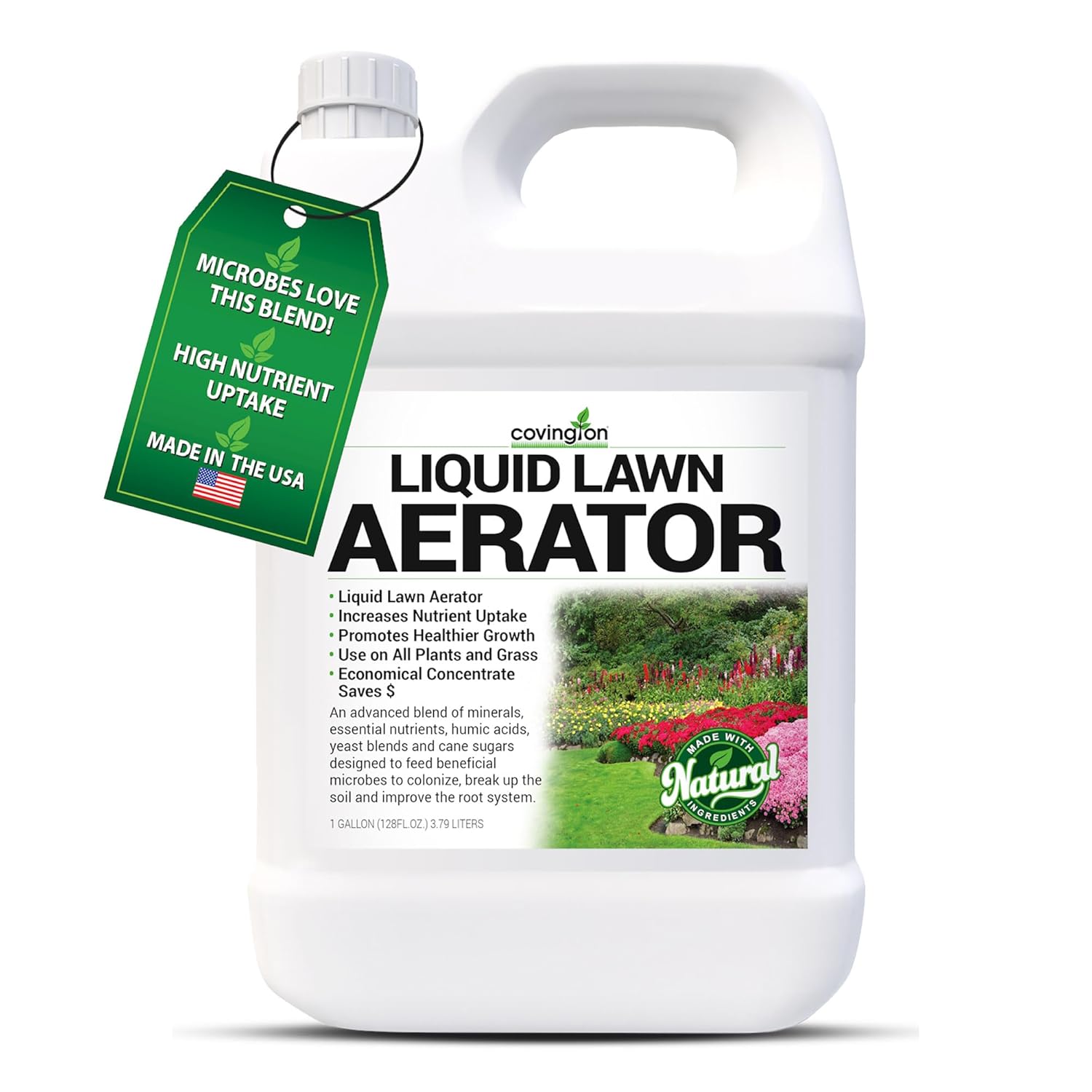 |
Covington Naturals Liquid Lawn AeratorBest Liquid Aerator | Liquid formula · Hose/spray application · No tools · Soil-conditioning approach | A no-equipment option for homeowners who want to improve soil without punching holes. | Check Price on Amazon |
Section 01
Why Lawn Aeration Matters More Than Most People Think
Ask ten homeowners what their lawn needs and you will hear watering, fertilizing, and mowing height — almost never aeration. Yet soil compaction is one of the most common reasons a lawn underperforms, and it quietly undermines everything else you do. Foot traffic, mowing equipment, clay-heavy soil, and years of neglect all press soil particles together until the pore space between them disappears. With no pore space, there is nowhere for oxygen to travel, nowhere for water to drain, and nowhere for roots to expand.
Once you know the symptoms, compaction becomes easy to spot. Water sits on the surface after rain or irrigation instead of soaking in. Grass feels spongy in places and thin in others. Weeds that tolerate hard ground — plantain, certain annual grasses — creep in along walkways. And moss, which thrives where turf struggles, gets a foothold in shaded, damp, compacted corners. If moss is already a battle for you, our guide on how to get rid of moss in lawn explains how aeration fits into the wider fix.
Aerating reverses the pattern by opening channels into the soil profile. In core aeration, hollow tines pull plugs of soil out of the ground, leaving behind holes that let air and water reach the root zone while relieving lateral pressure. Roots respond quickly, growing toward the newly loosened soil and thickening the turf from below. Within a season, the lawn feels different underfoot — firmer in a good way, denser, and far more resilient through heat and drought.
There is a knock-on benefit too: every other lawn-care product works better on an aerated lawn. Fertilizer drops into holes instead of sitting on thatch. Grass seed makes contact with soil rather than resting on a thatch layer to dry out and die. Watering becomes efficient instead of wasteful. That is why seasoned lawn-care routines treat aeration as the hinge step of the season — the one that multiplies the value of everything scheduled around it. If you are still building that routine, pairing aeration with our timing guides for overseeding and fertilizing (linked later in this article) will get you there faster.
Think of aeration as loosening the ground so the lawn can breathe, drink, and feed. Everything else on your calendar — seeding, feeding, watering — performs a notch better because of it.
Section 02
Types of Lawn Aerators Explained (and Which Lawns They Suit)
Not all aerators are built on the same idea. Some remove soil, some displace it, and some skip physical holes entirely. Understanding the five main categories will save you from buying a tool that looks impressive in a listing photo and disappoints on your actual lawn.
Tow-behind plug aerators hitch to a riding mower, lawn tractor, or ATV and drag hollow tines across the turf. As the tines press in, they cut and lift cores of soil, dropping them on the surface. This is the gold-standard method for large lawns because it removes compaction rather than adding to it, and coverage is fast. The trade-off is storage space and the need for something to tow with.
Tow-behind spike aerators use solid tines that push into the ground rather than removing plugs. They are lighter, cheaper, and easier to store, and they do a decent job of opening the surface for water and fertilizer. The caveat: solid spikes compress soil around the hole as they enter, so on heavy clay they can actually worsen compaction at depth. On loam and sandy lawns, they are perfectly sensible.
Manual coring tools are the hands-on answer for small to medium lawns. Hollow tines, a long handle, and your body weight on a foot plate do the work. They take longer per square foot, but they remove genuine cores, deliver precise control around garden beds and paths, and store in a corner of the shed.
Rolling aerators trade the stab-and-lift motion for a drum or spiked cylinder you push like a mower. The coverage per pass is wide and the effort is steady rather than explosive, which many homeowners prefer. Depending on the design, rollers either spike or core, so check which tine style it uses before assuming plug removal.
Aerator shoes and liquid aerators round out the field. Shoes strap spikes to your feet so that simply walking the lawn aerates it — low cost, zero storage, and genuinely useful for light compaction or for maintaining an already-corrected lawn. Liquid aerators take a completely different route, applying soil-conditioning formulas through a sprayer to encourage looser soil structure over time. They are the choice for anyone who cannot punch holes at all — renters, elderly gardeners, or lawns with buried irrigation lines.
Swipe to see more →
| Type | How It Works | Best Lawn Size | Removes Cores? | Effort Level |
|---|---|---|---|---|
| Tow-Behind Plug | Hollow tines pull soil plugs as you drive | Large to acreage | Yes | Low (ride-on powered) |
| Tow-Behind Spike | Solid tines puncture the surface | Medium to large | No | Low (ride-on powered) |
| Manual Coring Tool | Hollow tines + body weight extract cores | Small to medium | Yes | High but controlled |
| Rolling Aerator | Spiked or cored drum rolls across turf | Small to medium | Depends on design | Medium, steady pace |
| Aerator Shoes | Foot-mounted spikes with every step | Small to medium | No | Low (just walking) |
| Liquid Aerator | Spray-on soil conditioning formula | Any size | No | Very low |
Section 03
How to Choose the Right Aerator: A Practical Buying Guide
With the categories understood, the next question is narrower: which specific tool deserves a place in your shed? These are the factors that actually separate a good purchase from a regretted one.
Lawn size beats everything else
Be honest about square footage. Hand tools are genuinely satisfying on a small lawn and genuinely miserable on half an acre. Tow-behind units are the inverse — brilliant on wide open turf, absurd on a courtyard. As a rough guide: handheld and rolling tools suit compact and mid-size lawns, while tow-behind machines earn their keep once you are mowing with a tractor and covering serious distance.
Plug removal versus spike penetration
If your soil is clay-heavy and visibly compacted, plug removal is the more effective correction — those hollow tines physically take soil out and relieve pressure. Spike aerators are better thought of as maintenance tools for loam, sandy soils, or lawns that only compact lightly. Many homeowners end up owning both: a coring tool for the annual deep pass and a lighter option for touch-ups.
Build quality and tine material
The tines take all the abuse. They need to bite into hard ground without bending, and they need to survive being dragged across gravel edges and sprinkler heads. Favor robust construction, replaceable or serviceable tines where possible, and handles with real leverage. A cheap tool that folds on the first hard clay patch costs more than a decent one bought once.
Storage, assembly, and effort
Tow-behind units want garage floor space and some assembly time; manual tools want a wall hook. Consider how much assembly you are willing to do, how heavy the tool is when loaded, and whether the design folds or stands compactly. And think about physical effort honestly — hollow-tine coring by hand is a workout, and that is fine if you like it, but rolling and riding options exist for a reason.
Extras worth weighing
Weight trays on tow-behind models let you add downward force for deeper tine penetration. Foot plates on hand tools let your legs contribute instead of your lower back. Wide working widths cut pass counts. None of these are gimmicks — they are the difference between a tool you use and a tool you avoid. For lawns that also need feeding after aeration, pairing your aerator with one of the best broadcast spreaders makes the whole process a single afternoon job.
Section 04 · Reviews
Tow-Behind Aerators for Large Lawns
When the lawn is measured in fractions of an acre rather than square feet, walking behind a hand tool stops being charming very quickly. Tow-behind aerators turn the job into a drive, covering wide swaths in a fraction of the time and delivering consistent tine depth across the whole yard. The three models below represent the two approaches in this category: plug removal for serious correction, and spike penetration for lighter maintenance passes.
Swipe to see more →
| Product | Method | Width | Best For | Check Price |
|---|---|---|---|---|
| Top PickAgri-Fab 48″ Tow-Behind Plug Aerator | Core / plug removal | 48″ | Large lawns | Check Price on Amazon |
| Craftsman 40″ Tow-Behind Plug Aerator | Core / plug removal | 40″ | Mid-size to large | Check Price on Amazon |
| Seeutek 40″ Tow-Behind Spike Aerator | Spike penetration | 40″ | Light compaction | Check Price on Amazon |
Agri-Fab 48″ Tow-Behind Plug Aerator
Best for Large Lawns · Top PickAgri-Fab has been in the lawn-and-garden attachment business long enough that the name alone sets expectations, and this 48-inch tow-behind plug aerator is exactly the kind of machine that reputation is built on. Its job is simple and demanding: hitch it to a riding mower or tractor, drive the lawn, and have hollow tines pull real cores out of the ground across a broad working width.
The 48-inch span is the headline advantage. On a large lawn, width is time — every extra foot of coverage is a pass you do not have to repeat. Because it removes plugs rather than merely poking holes, it delivers the correction compacted clay and high-traffic turf actually need, and the dropped cores break down on the surface and return their nutrients to the lawn.
Key Features
- Tow-behind design — hitches to a riding mower, lawn tractor, or ATV so aeration becomes a drive rather than a workout.
- 48-inch working width — the widest coverage in this guide, ideal for acreage and expansive suburban lots.
- Core-removing tines — hollow tines extract soil plugs for genuine compaction relief rather than surface-only treatment.
- Weighted operation — designed to let added weight push tines deeper into harder soils.
- Season-after-season build — a robust frame intended for repeated annual use, not a single-season tool.
Pros
- Widest coverage per pass in this lineup
- True plug removal for real compaction relief
- Effortless compared with any manual method
- Trusted lawn-attachment brand
Cons
- Requires a towing vehicle
- Needs real garage or shed space
- Overkill for small or tight yards
Best for: Homeowners with a riding mower and a lawn big enough to justify it. If you spend more than a few minutes just driving from one end of the yard to the other, this is the aerator that makes the job disappear.
Check Price on Amazon
Craftsman 40″ Tow-Behind Plug Aerator
Best Premium Tow-BehindCraftsman is a name most homeowners already trust from the tool bench, and the brand’s take on a tow-behind plug aerator brings that same no-nonsense engineering to the lawn. At 40 inches wide, it covers slightly less ground per pass than the widest unit here, but that narrower footprint is actually an advantage on lawns with gates, landscaped islands, and winding edges where a bigger machine becomes awkward.
Like the other plug-style units, it removes cores rather than compressing soil around a spike, which makes it the right call for clay-heavy ground and anywhere traffic has packed the turf hard. The result is the classic aeration pattern: rows of neat plugs on the surface and open channels beneath that let roots, water, and air move freely.
Key Features
- 40-inch working width — wide enough for efficient coverage, narrow enough to navigate landscaped lawns comfortably.
- Plug-removing tines — hollow tines extract cores to relieve compaction instead of adding to it.
- Tow-behind convenience — attaches to compatible riding equipment for low-effort, consistent passes.
- Reputable brand support — backed by a long-established name in homeowner lawn and garden equipment.
- Repeat-season durability — built to be dragged out, used hard, and stored away year after year.
Pros
- Maneuverable around beds and gate openings
- True core removal for compacted soil
- Brand with strong lawn-equipment pedigree
- Consistent depth across the whole lawn
Cons
- Narrower than the widest tow-behind option
- Needs a towing vehicle and storage room
- More machine than a small lawn requires
Best for: Homeowners with a mid-size to large lawn full of beds, trees, and tight corners who still want the speed of a tow-behind. It is the sweet spot between coverage and control.
Check Price on Amazon
Seeutek 40″ Tow-Behind Spike Aerator
Best Tow-Behind SpikeNot every lawn needs plugs pulled out of it. For loam, sandy soils, and turf that is only lightly compacted, a spike aerator is a simpler, lighter, and more affordable way to open the surface and let water, feed, and air move in. That is exactly where the Seeutek 40-inch tow-behind spike aerator fits, and it brings the same drive-it-behind-the-mower convenience as the plug units at a friendlier level of complexity.
The solid tines punch a dense pattern of holes as you drive, breaking the surface crust and improving infiltration immediately. Because spikes displace soil rather than remove it, there are no plugs to deal with and no cleanup afterward — just a lawn that absorbs water and fertilizer noticeably better.
Key Features
- Spike-tine action — solid tines puncture the soil surface to improve water and nutrient infiltration.
- 40-inch working width — efficient, wide coverage for medium and large lawns.
- Tow-behind operation — hook it up and aerate while mowing or during a dedicated pass.
- Lightweight approach — easier to tow, store, and handle than a full plug-coring machine.
- No plug cleanup — the surface stays tidy with nothing to rake or mulch afterward.
Pros
- Fast, low-effort coverage
- Lighter and easier to store than plug units
- Great for routine maintenance passes
- Leaves the lawn looking untouched
Cons
- Does not remove soil cores
- Less effective on heavy clay than plug aerators
- Still requires a towing vehicle
Best for: Homeowners with loam or sandy lawns who want the speed of a tow-behind without the weight, cost, or plug cleanup of a coring machine. Also a smart seasonal top-up tool alongside an annual core pass.
Check Price on AmazonSection 05 · Reviews
Manual Coring Aerators: Real Cores, No Machine Required
Manual coring aerators are the purist’s tool. No gas, no cords, no batteries — just hollow tines, a handle, and your own body weight driving them into the ground. They are slower than any machine, and that is precisely their appeal: complete control, pinpoint accuracy around beds and paths, genuine core removal, and a tool that will still be working in a decade. The four models below cover the range from entry-level to heavy-duty, with two handle styles to choose from.
Swipe to see more →
| Product | Style | Method | Best For | Check Price |
|---|---|---|---|---|
| Top PickYard Butler Manual Lawn Coring Aerator | Foot-leverage corer | Hollow-tine core removal | All-round manual | Check Price on Amazon |
| Landzie Hollow Tine Fork Lawn Aerator | Long-handled fork | Hollow-tine core removal | Fork-style fans | Check Price on Amazon |
| hugeneroy Heavy Duty Hollow Tine Core Aerator | Heavy-duty corer | Hollow-tine core removal | Clay & hard soil | Check Price on Amazon |
| Xuperace Core Aerator Lawn Tool | Compact corer | Hollow-tine core removal | Budget buyers | Check Price on Amazon |
Yard Butler Manual Lawn Coring Aerator
Best Manual Coring ToolYard Butler is one of those quiet, enduring garden-tool brands that earns loyalty the hard way — by building things that simply do not break. Their manual lawn coring aerator is a perfect example: a long-handled hollow-tine tool that uses your body weight to extract real soil cores, one satisfying plunge at a time.
The design is deliberately simple. Position the tines, step down onto the foot plate, feel them sink in, rock them back, and lift out a pair of plugs. Repeat. Within a few minutes you find a rhythm, and within an afternoon the whole lawn is opened up. There is no engine to service, nothing to charge, and no learning curve beyond basic technique.
Key Features
- Hollow-tine coring action — removes actual soil plugs for the same compaction relief as a machine, just at hand speed.
- Foot-assisted leverage — a step plate lets your legs do the driving instead of your lower back.
- Long handle design — comfortable working posture for extended sessions.
- Zero maintenance — no fuel, no cords, no batteries, nothing to winterize.
- Classic tool durability — the kind of build that gets handed down rather than thrown away.
Pros
- Removes genuine soil cores by hand
- Excellent control around beds and edges
- Stores in a tiny footprint
- Essentially indestructible with basic care
Cons
- Physically demanding on large lawns
- Slow compared with any tow-behind
- Hard clay can test your patience
Best for: Small to mid-size lawns, gardeners who like simple tools that last forever, and anyone who wants real core aeration without owning a machine. It is also the perfect precision tool for spot-treating problem patches.
Check Price on Amazon
Landzie Hollow Tine Fork Lawn Aerator
Best Fork-Style CorerThe Landzie takes the classic garden fork concept and upgrades it with hollow tines, turning a familiar motion into proper core aeration. If you have ever used a border fork, you already know the technique — which makes this one of the most intuitive aerators to pick up and start using well.
What separates it from a plain digging fork is the tine geometry: the tines are hollow, so each push removes a small plug instead of compressing soil outward. The multi-tine layout means each plunge opens several holes at once, and the long handle keeps you upright and comfortable while you work across the lawn.
Key Features
- Hollow tine fork design — multiple core-removing tines per plunge for efficient coverage.
- Familiar fork-style technique — almost no learning curve if you have used garden hand tools before.
- Long, sturdy handle — keeps the working posture upright and reduces strain over longer sessions.
- Ground-contact durability — built to be shoved into hard soil repeatedly without complaint.
- Easy to store — a single tool that hangs neatly on a wall hook or leans in a corner.
Pros
- Very intuitive to use
- Several cores per plunge
- Great leverage on firm ground
- Minimal storage and zero upkeep
Cons
- Still manual — large lawns take time
- Cores can stick in wet, sticky clay
- Not ideal for very shallow root zones
Best for: Gardeners who prefer fork-style tools and want core removal without machinery. Excellent for medium lawns, established borders, and anyone correcting compaction in specific high-traffic zones.
Check Price on Amazon
hugeneroy Heavy Duty Hollow Tine Core Aerator
Best Heavy-Duty ManualSome soils fight back. If your lawn sits on heavy clay or ground that has been driven over and packed for years, a lightweight coring tool can flex, clog, or simply refuse to penetrate. The hugeneroy heavy-duty hollow tine core aerator is built for exactly that fight, with a reinforced construction and aggressive hollow tines designed to keep working where lesser tools give up.
This is not a delicate instrument — and that is the point. The tines are sized and shaped to bite into firm ground, lift clean cores, and survive contact with the odd stone or root. For homeowners who have already broken one aerator, this is the logical upgrade.
Key Features
- Heavy-duty hollow tines — aggressive core removal on clay and densely packed soils.
- Reinforced construction — built to absorb the punishment of hard-ground aeration without bending.
- True plug extraction — removes soil rather than displacing it, delivering real compaction relief.
- Manual control — precise placement around irrigation heads, beds, and hardscape edges.
- Season-spanning utility — equally useful in spring and fall renovation windows.
Pros
- Handles clay and hard-packed ground
- Robust build that resists bending
- Real cores for genuine correction
- Excellent for stubborn problem zones
Cons
- Heavier to wield than lighter tools
- Manual effort adds up on big lawns
- Over-specified for soft, sandy soils
Best for: Clay-soil lawns, driveways and play areas with serious compaction, and anyone who wants a manual coring tool that will not quit on hard ground.
Check Price on Amazon
Xuperace Core Aerator Lawn Tool
Best Budget Coring ToolNot everyone wants to commit a serious budget to aeration on the first try — especially if you are still working out how much of your lawn actually needs it. The Xuperace core aerator is the friendly entry point: an affordable, compact hollow-tine tool that delivers the real thing — actual core removal — without the price tag of premium hardware.
It is a great way to test the waters. Use it on the worst patch of lawn first, watch how the turf responds over the following weeks, and then decide whether you want to expand to a full-lawn routine or upgrade to a wider tool. Even if you later move up, this stays useful as a spot-treatment tool.
Key Features
- Hollow-tine core removal — the genuine method, not just surface poking, at an entry-level price.
- Compact, lightweight form — easy to handle, easy to store, easy to lend to a neighbor.
- Simple two-handed operation — no assembly marathon and no maintenance schedule.
- Spot-treatment friendly — ideal for dog runs, gate paths, and worn play zones.
- Low-risk purchase — a sensible way to try core aeration before investing more.
Pros
- Very accessible price point
- Removes real soil plugs
- Great for targeted problem areas
- Stores almost anywhere
Cons
- Slower on large lawns
- Less leverage than foot-plate designs
- Not intended for commercial-scale work
Best for: First-time aerator buyers, small lawns, and homeowners who want to correct problem patches before deciding on a bigger investment.
Check Price on AmazonSection 06 · Reviews
Stand-Up & Spike Manual Aerators for Quick Coverage
Spike aerators trade core removal for speed and simplicity. Solid tines push into the turf, opening channels for water and fertilizer, and the tools are lighter and faster to use than any coring alternative. They shine on loam and sandy soils, on small to medium lawns, and as maintenance tools between deeper treatments. The four models below range from wide multi-spike designs to ultra-compact spot tools.
Swipe to see more →
| Product | Format | Standout Trait | Best For | Check Price |
|---|---|---|---|---|
| Top PickBluesea 16-Spike Lawn Aerator | Wide multi-spike | Many spikes per pass | Fast coverage | Check Price on Amazon |
| Saker Manual Lawn Aerator | Stand-up manual | Easy handling | General use | Check Price on Amazon |
| Jardineer Spike Lawn Aerator | Compact spike tool | Light and quick | Small yards | Check Price on Amazon |
| evtmag Lawn Aerator | Value spike tool | Low-cost entry | Budget buyers | Check Price on Amazon |
Saker Manual Lawn Aerator
Best Stand-Up ManualThe Saker manual lawn aerator is built around one idea: keep it simple. It is a stand-up tool you grab, use, and put away — no complicated setup, no consumables, no learning curve. For homeowners who want to improve their lawn a little every weekend rather than tackle one exhausting renovation day, that simplicity is the entire value proposition.
It works well for regular maintenance passes across the lawn, hitting high-traffic lanes, and keeping the soil receptive to water and feed throughout the growing season. Because it is so quick to deploy, you are far more likely to actually use it — which, honestly, matters more than any single feature on a spec sheet.
Key Features
- Stand-up manual operation — comfortable working position with quick, repeatable plunges.
- Lightweight and agile — easy to carry around the yard and maneuver into tight corners.
- Minimal assembly — straightforward out-of-the-box setup with no fiddly hardware.
- Low maintenance — wipe it down, store it, done.
- Season-long usefulness — suitable for routine passes in spring, summer, and fall.
Pros
- Extremely easy to use and store
- Great for frequent light treatments
- Comfortable stand-up posture
- Very affordable way to start
Cons
- Spike method suits lighter compaction
- Not intended for heavy clay correction
- Coverage speed is limited on big lawns
Best for: Homeowners who want a grab-and-go tool for regular maintenance and quick passes around the lawn, especially on loam or sandy soils.
Check Price on Amazon
Jardineer Spike Lawn Aerator
Best for Small YardsSmall yards have different needs entirely. There is no room to store a tow-behind, no need for a wide working width, and every tool has to earn its keep in a tight space. The Jardineer spike lawn aerator is designed for exactly this reality: compact, light, and quick to use around patios, borders, side yards, and small patches of turf.
It is the kind of tool that lives by the back door. See a puddle forming after watering, or a patch thinning near the walkway? Grab it, spend five minutes opening the surface, and put it back. That accessibility turns aeration from an annual event into an ongoing habit.
Key Features
- Compact spike design — sized for small lawns, side yards, and tight landscaped areas.
- Lightweight handling — effortless to carry and position exactly where treatment is needed.
- Fast spot treatment — perfect for puddling areas, wear paths, and thinning patches.
- Simple construction — few parts to fail and nothing to service.
- Easy to store — fits in a small shed, garage corner, or balcony cupboard.
Pros
- Ideal size for compact lawns
- Quick to deploy and put away
- Great for precise problem-spot work
- Very light to handle
Cons
- Impractical for large lawns
- Spike method, not core removal
- Limited depth on very hard ground
Best for: Small yards, courtyard lawns, townhouse turf, and anyone who wants a lightweight tool for regular spot aeration without dedicating storage space.
Check Price on Amazon
Bluesea 16-Spike Lawn Aerator
Best Wide-Coverage SpikeMost manual spike aerators share the same limitation: a handful of tines per plunge means a lot of plunges per lawn. The Bluesea 16-spike design attacks that math directly. With a wide multi-spike layout, each pass opens a dense pattern of holes, so you cover more ground in fewer motions and finish the job while the enthusiasm is still there.
This is a genuinely clever format for mid-size lawns. You keep the simplicity and low cost of a manual tool but claw back much of the speed penalty that makes manual aeration feel endless. If you have been putting off aeration because of the time commitment, a wide-format tool like this changes the calculus.
Key Features
- 16-spike working layout — a dense hole pattern per pass for noticeably faster coverage.
- Wide single-pass treatment — fewer passes needed to cover the same square footage.
- Spike aeration method — opens the surface for water, feed, and airflow without removing plugs.
- Manual simplicity — no engine, no power source, no complicated assembly.
- Practical mid-size coverage — bridges the gap between spot tools and full machines.
Pros
- Fastest coverage of the manual spike group
- Dense, even hole pattern
- Keeps the low cost of a hand tool
- Good choice for regular maintenance
Cons
- Wider head can feel bulky in tight spots
- Does not remove soil cores
- Less suited to very hard clay
Best for: Mid-size lawns where manual aeration feels endless but a tow-behind is overkill. If you want the most ground covered per unit of effort in the manual category, this is it.
Check Price on Amazon
evtmag Lawn Aerator
Best Value Spike ToolThe evtmag lawn aerator covers the value end of the spectrum: an affordable spike-style tool that does the basic job without fuss. It is not trying to be the most sophisticated aerator on the market — it is trying to be the one you can buy today and start using this weekend, and at that it succeeds.
For rental properties, first homes, and anyone building a lawn-care toolkit piece by piece, this is a sensible starting point. Paired with good watering habits and a feed schedule, routine spike aeration keeps soil receptive and helps turf stay dense through the season.
Key Features
- Spike aeration design — opens the soil surface for improved water and nutrient movement.
- Value pricing — the lowest barrier to entry among the tools in this guide.
- Light, manageable build — easy for almost anyone to use comfortably.
- Negligible maintenance — clean, dry, and store it.
- Good starter tool — build the habit now, upgrade later if needed.
Pros
- Very budget friendly
- Simple to use with no setup
- Light enough for anyone to handle
- Handy for regular light passes
Cons
- Spike method only
- Best suited to lighter compaction
- Coverage is modest on large lawns
Best for: Budget-conscious homeowners, renters with lawn responsibilities, and anyone who wants to establish a regular aeration habit without a meaningful upfront investment.
Check Price on AmazonSection 07 · Review
Rolling Lawn Aerators: Aeration at Walking Pace
The rolling aerator is the least dramatic-looking tool in this guide and one of the most pleasant to use. Instead of stabbing the ground repeatedly, you push a spiked or tined drum across the lawn like a mower, and aeration happens continuously underneath you. It is steady, rhythmic work — and for many homeowners, that makes it far more likely to actually get done.
K.D STONEDGE Rolling Lawn Aerator
Best Rolling AeratorThe K.D STONEDGE rolling lawn aerator takes the drum approach seriously. You push it across the turf, the roller does the penetrating, and each pass leaves behind a consistent pattern of aeration holes. There is no plunging, no bending, and no foot plate — just walking, which is about as accessible as lawn care gets.
Rolling aerators also solve the storage problem elegantly. The format is compact and self-contained, so it takes up a fraction of the space a tow-behind demands while still delivering wide coverage per pass. For small to mid-size lawns where a machine would be absurd but a hand tool feels endless, this middle path makes a lot of sense.
Key Features
- Rolling drum action — continuous aeration as you push, with no plunging motion required.
- Wide per-pass coverage — the rolling format treats a broad strip of turf on every trip across the lawn.
- Walking-pace effort — steady cardiovascular work rather than bursts of heavy lifting.
- Compact footprint — stores far more easily than tow-behind equipment.
- Consistent treatment pattern — even hole spacing across the entire lawn.
Pros
- Easiest aeration motion of any manual tool
- Fast, even coverage on open turf
- Compact to store
- No bending or repetitive plunging
Cons
- Needs open space to build a rhythm
- Less precise around beds and edges
- Push effort is still real on slopes
Best for: Small to mid-size lawns with open layout, and anyone who finds plunging-style tools tiring or awkward. If you like the idea of aerating at the same pace you mow, this is your format.
Check Price on AmazonSection 08 · Reviews
Aerator Shoes & Liquid Aeration: The Zero-Equipment Options
At the far end of the spectrum sit the methods that require almost nothing from you. Aerator shoes strap spikes to your feet so the simple act of walking the lawn aerates it. Liquid aerators go further still, replacing holes altogether with a spray-on soil-conditioning approach. Purists will argue they are not substitutes for core aeration — and on heavy clay, they are right — but for light compaction, maintenance, and situations where punching holes is simply not possible, these are legitimate tools.
Swipe to see more →
| Product | Method | Effort | Best For | Check Price |
|---|---|---|---|---|
| Top PickBakulala Lawn Aerator Shoes | Foot-mounted spikes | Walking only | Hands-free aeration | Check Price on Amazon |
| DenForste Lawn Aerator Shoes | Foot-mounted spikes | Walking only | Budget shoes | Check Price on Amazon |
| Covington Naturals Liquid Lawn Aerator | Spray-on formula | Spraying only | No-hole aeration | Check Price on Amazon |
Bakulala Lawn Aerator Shoes
Best Aerator ShoesAerator shoes are the most delightfully lazy idea in lawn care, and the Bakulala version executes it well. Strap them over your regular shoes, and every step you take across the lawn drives spikes into the turf. Walk the dog, water the garden, fetch the mail — it all counts as aeration.
Are they as effective as a core aerator on compacted clay? No, and it would be misleading to say otherwise. But for light compaction, for maintaining a lawn after a proper core treatment, and for homeowners who cannot manage heavy tools, they offer genuine value at almost no cost in money or effort. The strap-on design also means they take up essentially zero storage space.
Key Features
- Foot-mounted spike design — aeration happens with every step you take across the lawn.
- Strap-on compatibility — secures over ordinary shoes for immediate, no-fuss use.
- Hands-free operation — no tools to hold, no plunging, no bending.
- Ultra-compact storage — hangs in a corner or slides into a drawer.
- Reusable across seasons — bring them out whenever the lawn needs a light pass.
Pros
- Closest thing to zero effort
- Very low cost
- Great for maintenance between core sessions
- No storage or maintenance burden
Cons
- Not a substitute for core aeration on clay
- Shallow penetration compared with tools
- Takes getting used to walking in them
Best for: Light compaction, maintenance passes, and homeowners who want to keep aerating without any equipment commitment. Also a fun way to involve the whole family in lawn care.
Check Price on Amazon
DenForste Lawn Aerator Shoes
Best Budget Aerator ShoesThe DenForste aerator shoes make the same promise as every shoe-style aerator — walk and aerate simultaneously — at a very approachable price. Adjustable straps keep them attached to your footwear, and the lightweight construction means you can wear them for extended passes without fatigue.
This is the entry-level way to try shoe aeration. If you find yourself reaching for them regularly and want more penetration, you can always graduate to a handheld coring tool later. As a first step toward better soil, though, they are hard to argue with on value.
Key Features
- Adjustable strap system — fits over a range of everyday footwear securely.
- Lightweight construction — comfortable enough for long walks across the lawn.
- Spike-based aeration — opens the surface for improved water and air movement.
- Reusable design — clean them off and store them for the next pass.
- Budget-friendly entry — minimal investment to start an aeration habit.
Pros
- Very affordable
- Comfortable, lightweight wear
- Adjustable fit over most shoes
- Effectively zero storage
Cons
- Shallow spike penetration
- Straps need checking as you walk
- Not designed for heavy compaction
Best for: Budget shoppers, small lawns, and anyone curious about shoe aeration who wants to try it without spending much.
Check Price on Amazon
Covington Naturals Liquid Lawn Aerator
Best Liquid AeratorLiquid lawn aeration is a completely different philosophy. Rather than physically opening holes in the soil, products like the Covington Naturals liquid lawn aerator apply conditioning formulas through a sprayer, working to improve soil structure and permeability over time. For anyone who cannot punch holes — rental properties, lawns with buried lines, physical limitations — it is the only real option in this guide.
The appeal is obvious: application takes minutes with a hose-end sprayer or watering can, there is zero heavy equipment, and you can treat the entire lawn in a single session. It is also a natural complement to mechanical aeration, helping maintain loose, receptive soil between core treatments.
Key Features
- Liquid soil-conditioning formula — works to improve soil structure and permeability without physical holes.
- Spray-on application — treats the whole lawn quickly with a hose-end sprayer or watering can.
- No equipment required — nothing to tow, push, plunge, or strap on.
- Suitable for any lawn size — coverage scales with how much you mix and apply.
- Pairs with mechanical aeration — useful for maintaining soil receptivity between core treatments.
Pros
- Fastest application of any method
- Zero physical effort or equipment
- Works where holes cannot be punched
- Easy to add to a feeding routine
Cons
- Results build gradually rather than instantly
- Not a replacement for core aeration on hard clay
- Recurring application needed
Best for: Homeowners who cannot use mechanical aeration, anyone maintaining soil between core treatments, and lawns with irrigation systems or hardscape that make hole-punching risky.
Check Price on AmazonSection 09
Spike vs Plug vs Liquid: Which Aeration Method Actually Wins?
This is the debate that generates the most confusion in lawn-care communities, so let us settle it with context rather than dogma. Each method wins in specific circumstances, and the “best” method depends entirely on your soil, your lawn size, and your goals.
Plug (core) aeration is the strongest corrective treatment. Hollow tines remove soil, physically relieving compaction and leaving deep channels that persist for weeks. On clay soils, high-traffic turf, and lawns being renovated with seed and fertilizer, nothing else matches it. If you can only do one thing to a struggling lawn and you can access a coring tool or machine, this is the move.
Spike aeration is the practical maintenance method. It opens the surface crust, improves infiltration immediately, and can be done quickly and often. The important nuance is that solid spikes displace soil laterally as they enter, which on already-compacted clay can tighten the surrounding ground. That makes spikes excellent on loam and sand, and questionable as a standalone solution on heavy clay. Think of spike aeration as routine upkeep and core aeration as the annual correction.
Liquid aeration plays a different game entirely. Rather than creating holes, it works on soil structure over time, improving permeability through chemistry rather than mechanics. It will not rescue severely compacted clay overnight, but it is the only option for people who cannot punch holes at all, and it is a sensible partner to mechanical methods for keeping soil receptive between treatments.
Swipe to see more →
| Factor | Plug / Core | Spike | Liquid |
|---|---|---|---|
| Relieves heavy compaction | Best option | Limited on clay | Gradual over time |
| Speed of coverage | Fast with machines | Fast with any tool | Fastest overall |
| Physical effort | Low to high | Low to medium | Minimal |
| Works near irrigation lines | Use caution | Use caution | No risk |
| Best role | Annual correction | Regular maintenance | Support & no-hole cases |
| Best soil type | Clay & compacted | Loam & sand | All types |
Most homeowners land on a combination: a core aeration pass once a year on the worst areas, lighter spike or shoe passes through the season to keep the surface open, and a liquid treatment where physical holes are impractical. That layered approach outperforms any single-method obsession.
Section 10
When and How Often to Aerate Your Lawn
Even the best aerator produces disappointing results at the wrong moment. Timing matters because aeration is stressful to grass in the short term — you are, after all, driving holes into the root zone — and the turf needs to be in an active growing state to recover and fill in. Aerating during dormancy or peak heat stress leaves you with a lawn that sits damaged instead of rebounding.
The two classic windows align with active growth: the spring awakening and the fall cool-down. Fall is widely preferred by lawn-care professionals because soil is still warm, weeds are slowing down, and the grass can devote energy to root recovery rather than fighting summer heat. Spring aeration works well too, especially combined with the first feed of the season. For a detailed breakdown of seasonal timing, our guide on when to overseed a lawn covers the same growth windows that aeration depends on.
Frequency depends on soil and use. Clay lawns, households with kids and pets, and any turf that sees foot or vehicle traffic benefit from an annual pass. Sandy, lightly used lawns may only need treatment every couple of years. Watch the lawn itself: if water pools on the surface, if the soil feels hard underfoot, if the turf is thinning despite good feeding and watering, it is time.
Preparation matters as much as timing. Water the lawn a day or two before aerating so the soil is moist but not saturated — soft enough for tines to penetrate, firm enough to hold a clean hole. Mow slightly shorter than usual beforehand so tines reach soil rather than thatch, and pick up clippings with one of the best lawn sweepers if your mower leaves heavy debris behind.
- Grass is actively growing and greening up
- Soil is moist from rain or watering a day or two prior — never bone dry, never waterlogged
- Lawn is mowed a notch shorter than usual
- You have a plan for what comes next: seed, feed, or simply watering
Section 11
Aeration Best Practices & Aftercare That Multiplies Results
Aeration is the opening move, not the finish line. What you do in the hours and days after punching holes determines how much of that effort actually shows up in the lawn. The good news is that aftercare is straightforward, and it plugs into routines you are probably already running.
Leave the cores where they fall
After core aeration, the lawn will look like it has been visited by some kind of soil-prairie dog. It is tempting to rake them up. Resist. Those plugs break down within a couple of weeks, returning soil and microorganisms to the surface and further helping to decompose thatch. Run a mower over them once they have dried if the look bothers you.
Overseed immediately
Freshly aerated soil is the best seedbed you will ever have. Seed drops into holes where it makes direct contact with soil, stays moist, and germinates far more reliably than seed spread over thatch. This is the single biggest upgrade to a fall lawn-care day: aerate, then overseed in the same session. Our full guide on how to overseed a lawn in fall walks through the process step by step, and pairing it with one of the best lawn seed for overseeding removes the guesswork from seed selection. If you are wondering about germination expectations, how long grass seed takes to grow sets realistic timelines.
Feed into the holes
Fertilizer applied right after aeration reaches the root zone instead of sitting on the surface. This is exactly why when to fertilize a lawn and aeration timing are usually planned together, and why fall feeding with one of the best fall lawn fertilizers after a core pass produces such visible thickening the following season.
Water wisely afterward
Water deeply and less frequently in the days after aeration. The holes help moisture reach the root zone, so make the most of them. Deep watering also encourages roots to grow downward toward that moisture, which is exactly the drought-resistance upgrade you are after.
Fix bare spots while you are at it
If aeration reveals thin or bare patches — and it usually does — deal with them on the same day. Soil is open, seed is out, and the fix takes minutes. Our guide on how to fix bare spots in lawn covers repairs that stick. And if thatch is part of the problem, run through how to dethatch a lawn before aerating so tines reach soil instead of spongy dead material.
Clear the lawn first
Debris and thick leaf cover block tines and hide obstacles like sprinkler heads and stones. Before the aerator comes out, clear the lawn properly — how to get rid of leaves on a lawn covers fast approaches, and a good sweeper makes the job painless. For heavier cleanup duty, a leaf mulcher vacuum turns a mountain of leaves into useful mulch.
Section 12
Maintenance, Storage & Safety for Aerator Tools
Aerators are simple tools, and that simplicity is exactly why they get neglected. A little maintenance after each use keeps tines sharp and penetrating, prevents rust from setting in during storage, and extends the working life of tools that are otherwise remarkably long-lived.
Clean after every session
Soil clings to tines and dries into concrete. Rinse or scrape the tines immediately after use while the soil is still damp, and clear any cores lodged inside hollow tines with a rod or screwdriver. Clogged tines stop removing plugs and start compacting soil — the exact opposite of the job.
Keep tines sharp and serviceable
Dull tines struggle to penetrate and tear the turf rather than cutting cleanly. Check tines before each season, and file or replace them if the edges are rounded. This is the same principle as mower maintenance — how to sharpen a lawn mower blade explains why cutting cleanly matters, and the logic applies to every soil-penetrating edge.
Store dry and off the ground
Hang manual tools on a wall hook or stand them where air circulates. Tow-behind units should be stored on a flat surface with tines raised off the floor if possible. A light wipe of oil on metal tines before long storage prevents rust, and any fasteners should be checked for tightness before the next season.
Work safely
Manual aerators demand stable footing, especially on slopes — wear shoes with real grip and avoid swinging tools near bystanders. Tow-behind units add moving equipment to the equation: keep children and pets well clear, disconnect the unit before clearing clogs, and never stand between the towing vehicle and the implement on a slope. And before any tool goes into the soil, walk the lawn and mark sprinkler heads, shallow utility lines, and buried cables — an expensive lesson that is entirely avoidable.
Think about the wider machine care
If you are tow-behind owner, your mower is doing double duty as a tractor, and it deserves the same seasonal attention. Our guides on how to winterize a lawn mower and the broader how to winterize a lawn cover the end-of-season routine, while when to stop mowing the lawn helps you time the last cut before tools go into storage.
Questions & Answers
Frequently Asked Questions About Lawn Aerators
These are the questions homeowners ask most often when choosing and using a lawn aerator. Straight answers, no filler.
Why should I aerate my lawn at all? +
Soil compaction is the main reason. Foot traffic, mowing equipment, and clay-heavy soils press soil particles together until air, water, and roots cannot move through the profile. Aeration opens channels into the soil, relieving that pressure and allowing the root zone to breathe and hydrate. The visible payoff is thicker turf, better water absorption, and fertilizer that actually works instead of washing away.
What is the difference between a spike aerator and a plug aerator? +
A plug (or core) aerator uses hollow tines that pull cylindrical plugs of soil out of the ground, physically removing compaction. A spike aerator uses solid tines that push into the soil and displace it sideways. Plug aeration is more effective on heavy clay and severely compacted areas; spike aeration is faster, lighter, and well suited to loam, sandy soils, and routine maintenance between core treatments.
When is the best time of year to aerate? +
Aerate when grass is actively growing so it can recover quickly. That typically means the spring green-up or the fall cool-down, with fall widely favored because soil stays warm, weed pressure drops, and roots recover vigorously. Avoid aerating during summer heat stress or winter dormancy. Timing guidance in our overseeding and fertilizing articles covers the same growth windows.
How often should I aerate my lawn? +
It depends on soil type and use. Clay lawns, family lawns with kids and pets, and turf that sees regular traffic benefit from an annual pass. Sandy soils and lightly used lawns may only need it every couple of years. The lawn tells you when: pooling water, hard soil underfoot, and thinning grass despite good care are all signals that compaction has returned.
Should I aerate before or after overseeding? +
Always aerate before overseeding — ideally in the same session. Freshly opened holes give seed direct contact with soil, which dramatically improves germination compared with spreading seed over thatch. Aerate, seed, apply a light layer of feed, and water in. This combination is the single most effective fall renovation step for a tired lawn.
Can I aerate a wet lawn? +
Moderately moist soil is ideal; saturated soil is not. Water the lawn a day or two before aerating so tines penetrate easily without clogging. If the soil is waterlogged, wait — wet clay smears and compacts around the tines rather than releasing clean cores, which works against you. Bone-dry soil is just as bad, since tines barely penetrate.
Do aerator shoes actually work? +
They work for what they are: a low-effort way to add surface aeration through everyday walking. They are useful for light compaction, for maintaining a lawn after proper core aeration, and for people who cannot manage heavy tools. On heavily compacted clay, though, they lack the penetration of hollow-tine tools, so treat them as a supplement rather than a complete solution.
Do liquid lawn aerators really work? +
Liquid aerators take a different approach from physical tools. Rather than creating holes, they apply soil-conditioning formulas designed to improve soil structure and permeability over time. They are a practical choice for anyone who cannot punch holes — rental properties, lawns with buried irrigation lines, or physical limitations — and a useful partner to mechanical aeration between treatments. Results build gradually and are best combined with good watering and feeding habits.
Should I remove the soil plugs after core aeration? +
No — leave them on the lawn. The plugs break down within a couple of weeks and return soil and microorganisms to the surface, which also helps decompose thatch. If the look bothers you, run a mower over them once they have dried and crumbled. Raking them up simply removes good soil from your lawn.
How deep should aeration holes be? +
Deeper is generally better for compaction relief, which is why proper core aerators use hollow tines of meaningful length and why adding weight to tow-behind units helps. Rather than chasing an exact number, focus on the conditions that make deep penetration possible: moist soil, sharp tines, and steady, even passes. Shallow poking on dry, hard ground achieves very little.
Can I aerate a newly seeded lawn? +
Give new grass time to establish before aerating. Young roots need to anchor and thicken first; aerating too early can uproot seedlings and undo weeks of progress. Once the turf is dense enough to withstand normal mowing and foot traffic, it can handle aeration like any established lawn.
What should I do immediately after aerating? +
Overseed if the lawn is thin, apply fertilizer so nutrients drop into the open holes, and water deeply to settle everything in. Leave the cores on the surface to break down, and keep foot traffic light for a few days while the lawn recovers. This aftercare window is where the real results come from.
Final Verdict
The Right Aerator Is the One You Will Actually Use
After fifteen tools and a dozen deep dives, the pattern is clear: there is no single best lawn aerator — only the best aerator for your lawn, your soil, and your appetite for yard work. For sprawling turf with a riding mower in the shed, the Agri-Fab 48″ tow-behind plug aerator makes the job disappear into an afternoon drive. For compact and mid-size lawns where real core removal matters, the Yard Butler manual coring aerator and the Landzie hollow tine fork deliver machine-grade results at hand-tool scale. For loam soils and easy seasonal upkeep, spike tools like the Bluesea 16-spike, Saker, Jardineer, and evtmag keep the surface open with minimal effort. Rolling aerators like the K.D STONEDGE suit anyone who prefers walking to plunging, while the Bakulala and DenForste shoes and the Covington Naturals liquid formula cover the zero-equipment end of the spectrum.
Whichever you choose, commit to the timing and aftercare around it. Aerate while the grass is actively growing, on soil moist enough for tines to do their work. Seed into the holes, feed into the holes, water deeply afterward, and leave the cores where they land. That rhythm — more than any single tool specification — is what turns a thinning, compacted lawn into the dense green one you actually want to walk on barefoot.
Your next step is simple: match the category to your yard, pick the model that fits your budget and storage space, and get it before the next aeration window opens.
Keep Reading
You May Also Like
More guides to round out your lawn-care toolkit and seasonal routine.
Quiet, clean mowing power to pair with your aeration and feeding routine.
Cleanup Best Leaf Mulcher VacuumTurn leaf mountains into useful mulch before the final treatments of the season.
Maintenance How to Sharpen a Lawn Mower BladeClean cuts mean healthier grass — the same principle that keeps aerator tines effective.
Tool Review Do Lawn Sweepers Work?What lawn sweepers realistically handle — and when they save you an afternoon of raking.