

Best Lawn Sweeper: Top Picks for Leaves, Clippings, Pine Needles and Yard Debris
A lawn sweeper is the quiet shortcut between a raked-out Saturday and a yard that looks finished. Here are the push and tow-behind models worth your money, how they differ, and how to match one to your lawn.
Heads up: some links on this page are Amazon affiliate links. If you buy through them we may earn a small commission at no extra cost to you, and it helps keep this site running.
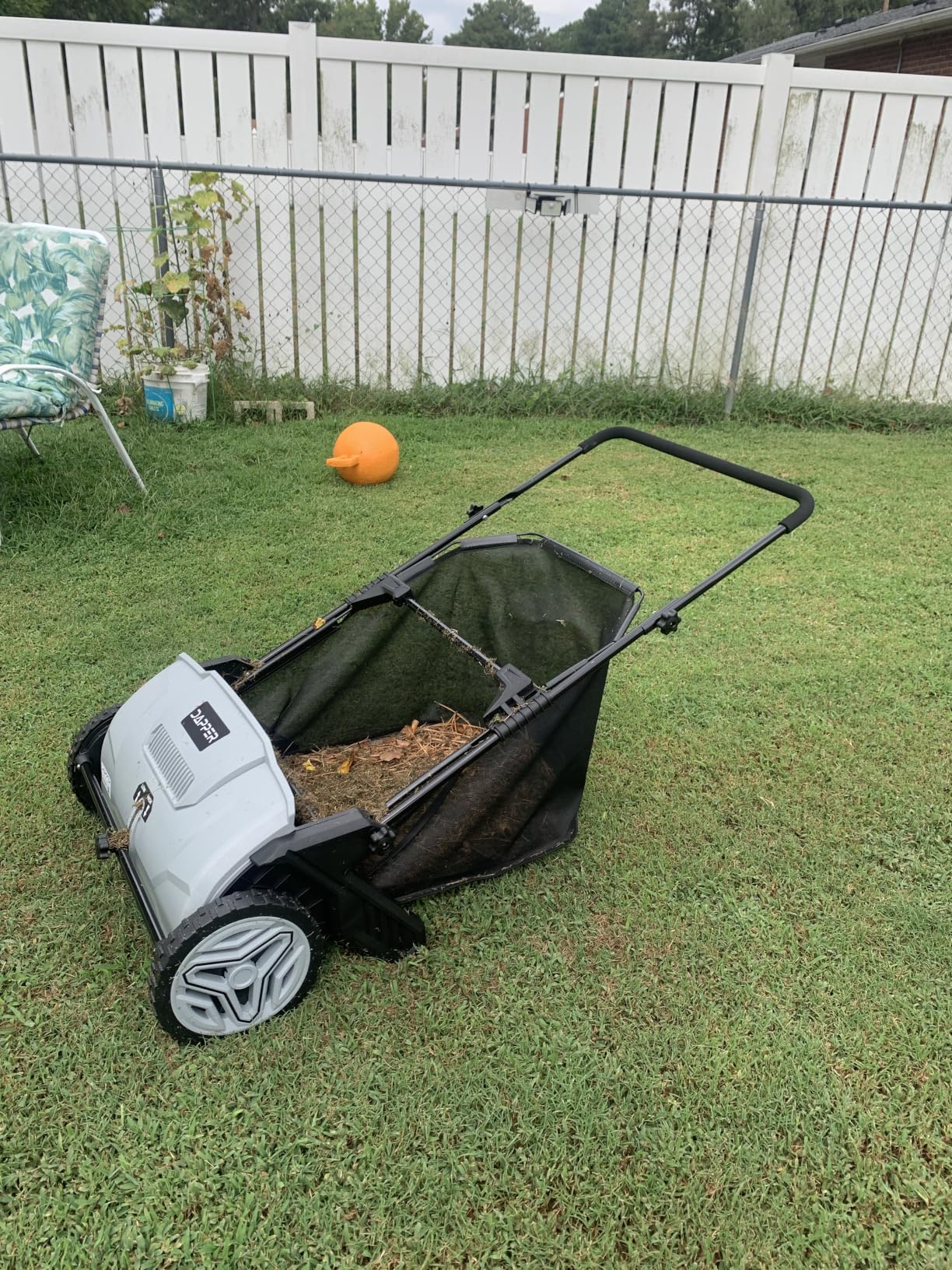
Every lawn owner knows the moment. The mower is put away, the edges look sharp, and then a stiff wind drops half a maple tree on the grass. Raking takes hours, bagging takes more, and a blower just shoves the mess into the neighbor’s yard or the flower bed you finished last week. A lawn sweeper solves that with the simplest mechanism imaginable: wheels turn brushes, brushes throw debris into a hopper, and you empty the hopper where you want it.
The trouble is that sweepers vary a lot. A 26-inch push model suits a townhouse backyard and would be miserable on three acres. A 50-inch tow-behind that eats a big lot in a few passes will not squeeze through a garden gate. The good news is that once you understand a handful of design choices, the right pick becomes clear fast.
We compared eleven popular sweepers across push, tow-behind and combo designs, looking at sweeping width, hopper size where it is listed, build style, how each connects to a tractor or mower, and the kind of feedback owners tend to repeat. Below you will find honest breakdowns, pros and cons, a side-by-side table, a full buying guide, and practical advice on using and storing your sweeper so it lasts.
What a Lawn Sweeper Actually Does (and Where It Shines)
A lawn sweeper is a wheeled collector that picks up loose debris from the surface of your lawn. Unlike a leaf blower, it does not move material around. Unlike a vacuum, it does not need a motor, fuel or a power cord. Most models are completely mechanical. As the wheels roll forward, a drive system spins a cylindrical brush set. The bristles reach down to the top of the turf, lift debris and fling it up and back into a fabric or mesh hopper. When the hopper is full, you pull a release, dump it, and keep going.
That simplicity is why sweepers have stayed popular for decades. There is very little to break. There is nothing to refuel. And because the work happens while you walk or drive at an ordinary pace, a lawn that once ate a weekend can be cleared in an hour or two.
What sweepers pick up well
Dry leaves are the headline job, and the one most people buy for. But a good sweeper handles far more than leaves. Pine needles, small twigs, pinecones, acorns, spent flower petals, seed pods, grass clippings from a side-discharge mower, thatch pulled up by dethatching, and even golf balls and small litter all get swept into the hopper. Homeowners with pine, oak, sweetgum or walnut trees often find that a sweeper pays for itself in the first season simply by saving the back pain.
What sweepers do not do
Honesty matters here, because the most common complaint from buyers is a mismatch between expectations and the tool. A sweeper is not a mulcher and it will not shred anything. It struggles with wet, matted leaves that have bonded to the grass, because the bristles cannot lift what is stuck down. It will not handle large branches. And it is not a replacement for good mowing habits: if the grass is very long or the ground is very uneven, brushes will skip and leave strips behind.
If you are still weighing whether a sweeper earns its place in your shed, our breakdown on whether lawn sweepers really work walks through the real-world results, and it is a good companion to this guide.
Who benefits most
- Owners of mature trees. Heavy leaf drop in autumn is the classic use case, and a sweeper makes cleanup something you can finish in a morning.
- Anyone with pine needles or twigs. These are awkward for rakes and bag mowers, but sweepers pick them up reliably when the lawn is dry.
- People with bad backs, shoulders or knees. Pushing a sweeper is far gentler than hours of raking and lifting tarps.
- Lawns with a tractor or ride-on mower. A tow-behind unit turns a two-minute hitch-up into a full-yard cleanup.
- Gardeners who want free organic material. Swept leaves and clippings can go straight to a compost pile or be shredded for mulch.
Quick tip: Sweepers work best on a short, dry lawn. If you can get a mow in first, you will pick up more in fewer passes and the brushes will wear more slowly.
How the brush and hopper system works
Understanding the mechanism makes it much easier to troubleshoot and to buy well. The wheels are linked to the brush by a simple drive, usually a belt, chain or gear set. As you move forward, the wheel rotation spins the brush. The brush turns in the direction that sweeps material up and back, so debris is lifted from the grass and thrown into the hopper behind it. A baffle or deflector helps keep material inside as it lands.
Because the brush speed depends on how fast the wheels turn, a sweeper works best at a steady, moderate pace. Go too slowly and the brush does not have enough speed to throw debris. Go too fast and the bristles can skip over debris before they have time to catch it. That balance is something you will feel after the first few minutes of using any sweeper.
Seasons when a sweeper earns its keep
Autumn is the obvious one, but it is far from the only one. In early spring, a sweep clears winter debris, fallen twigs and dead grass so the lawn can green up cleanly. In summer, it collects clippings, seed pods and spent blossoms. After storms, it clears scattered litter from windy days. Owners who use the sweeper across several seasons usually find it one of the most used attachments they own, which makes the purchase easier to justify.
Ready to compare current prices? See the most popular lawn sweepers on Amazon, with live pricing and owner reviews.
Shop Lawn Sweepers on AmazonOur Top Lawn Sweeper Picks at a Glance
If you only want the shortlist, start here. The table below places every model we cover side by side, and the quick-pick list underneath tells you which one to look at first based on how you will use it. Full write-ups follow in the sections after.
| Model | Type | Sweeping width | Best for |
|---|---|---|---|
| Agri-Fab 45-0492 | Tow-behind | 44 inches | Large lawns with a tractor or ride-on mower |
| Ohio Steel 50-Inch | Tow-behind | 50 inches | Big properties and heavy leaf drop (26 cu ft hopper) |
| AllFitHD 50-Inch | Tow-behind | 50 inches | Wide coverage on a budget-minded setup |
| Agri-Fab 45-0320 | Tow-behind | 42 inches | Mid-size lawns and compact tractors |
| VEVOR 42-Inch | Tow-behind | 42 inches | Value-focused tow sweeping (12 cu ft hopper) |
| Agri-Fab 48-Inch Aerator and 44-Inch Sweeper Combo | Tow-behind combo | 44-inch sweeper | Owners who also want to aerate with one tow setup |
| Agri-Fab 45-0218 | Push | 26 inches | Small to medium yards without a tractor |
| VEVOR 26-Inch Push | Push | 26 inches | Budget push sweeping for tidy yards |
| Earthwise LSW70021 | Push | 21 inches | Small lawns, patios and tight gates |
| Dapper Supply Push Sweeper | Push | See listing | Light-duty push sweeping on small spaces |
Quick picks by situation
- Best for big lots: the Ohio Steel 50-Inch, thanks to its wide sweep path and large hopper.
- Best all-rounder for tractors: the Agri-Fab 45-0492, a long-established name with a straightforward 44-inch design.
- Best value for width: the AllFitHD 50-Inch, which gives you a wide pass without a premium label.
- Best for mid-size lawns: the Agri-Fab 45-0320 or the VEVOR 42-Inch, depending on whether you value brand track record or price.
- Best two-in-one: the Agri-Fab aerator and sweeper combo for people who already plan to aerate every year.
- Best push sweeper overall: the Agri-Fab 45-0218 for its 26-inch width and sturdy reputation.
- Best for small, tight spaces: the Earthwise 21-Inch, which fits through narrow gates and around beds.
Sweeping widths above come from the product names. Hopper capacities, brush counts and weights change between model revisions, so always check the current listing before you order, especially if you need to match a hitch or fit inside a particular shed.
Want the full lineup in one place? Browse tow-behind and push sweepers together and sort by price or rating.
See Tow-Behind SweepersTow-Behind vs Push Sweepers: Which Style Fits Your Yard?
This is the first real decision, and it is mostly about the size of your lawn and what you already own. Both styles use the same basic mechanism, but they feel very different in use. Get this choice right and everything else is detail.
Tow-behind sweepers
A tow-behind sweeper hooks to the rear of a lawn tractor, zero-turn mower with a hitch, or utility vehicle. The wide sweeping path, typically somewhere between 40 and 50 inches, means fewer passes. The hoppers are bigger, so you stop to dump less often. And because you are sitting down and driving, a large yard feels manageable instead of punishing.
The tradeoffs are storage space and hitch compatibility. These are large, bulky tools. You also need a mower or tractor with a rear hitch point, and you should confirm the sweeper’s hitch style matches. Tow-behinds also need a bit more room to turn, so very cluttered yards with lots of beds and trees can be fiddly.
Push sweepers
A push sweeper is exactly what it sounds like. You walk behind it, and your forward motion drives the brush. They are lighter, cheaper, easier to store, and far more maneuverable. For a typical suburban lot, a good push model can clear the yard in a reasonable session without any additional equipment.
The limits are the flip side of those strengths. Narrow widths and small hoppers mean more passes and more trips to dump. On a half-acre or more, pushing becomes real work, especially when the hopper is full of heavy, damp debris. Push sweepers are also more sensitive to uneven ground, because you feel every bump through the handle.
A simple rule of thumb
| Your situation | Better fit |
|---|---|
| Under about a quarter acre, no tractor | Push sweeper |
| Quarter to half acre, no tractor | Push for light debris, or consider adding a tow-behind later |
| Half acre or more with a ride-on mower | Tow-behind sweeper |
| Heavy leaf drop from mature trees | Tow-behind, or a large push model with frequent emptying |
| Narrow gates, tight beds, patios | Push sweeper |
| You aerate or dethatch each year too | Tow-behind, ideally the combo |
If you are on the fence, think about the worst day of the year. A tow-behind is overkill in spring, but the week after the big leaf drop in autumn, you will be glad of every inch of width. A push sweeper wins on the other 300 days by being easy to grab and store.
Know your style? Compare push models side by side before you decide.
Shop Push Lawn SweepersBest Tow-Behind Lawn Sweepers for Large Lawns
If you own a lawn tractor and more than half an acre of grass, this is where you should be looking. These three models give you wide sweeping paths and big hoppers so you spend your time driving instead of dumping.

Agri-Fab 45-0492 44-Inch Tow-Behind Lawn Sweeper
Best all-rounder for tractorsAgri-Fab has been building lawn attachments for a very long time, and the 45-0492 shows the benefit of that experience. It is a classic tow-behind design: a 44-inch sweeping path, a fabric hopper with a quick-release dump handle, and a brush system driven directly by the wheels. There are no engines, no belts to tune, and no electronics.
The 44-inch width hits a useful sweet spot. It is wide enough to cut a big lawn’s cleanup time dramatically, but still narrow enough to handle gate openings, tree rings and the occasional awkward corner. For most owners of lawn tractors and mid-size ride-on mowers, this is the sweeper that simply fits.
Brand familiarity counts for a lot with attachments. Replacement hardware, brushes and hopper parts for Agri-Fab products are generally easy to find, which matters when a tool is going to see seasonal use for many years.
What we like
- Proven, no-fuss design
- Wide enough to save real time
- Easy dump handle from the seat
- Parts and support are easy to source
Keep in mind
- Needs a tractor or mower with a hitch
- Takes up real shed or garage space
- Wet leaves will reduce pickup

Ohio Steel 50-Inch Tow-Behind Lawn Sweeper (26 cu ft)
Best for big propertiesOhio Steel built its reputation on heavy-duty lawn and garden attachments, and this 50-inch model is aimed squarely at owners with serious acreage or serious leaf fall. The headline figure is the hopper: 26 cubic feet of capacity means far fewer stops. On a property where a smaller hopper would be dumped every couple of minutes, that adds up to a noticeable time saving.
The 50-inch sweeping path is also one of the widest you will find in this class. If you have long open runs of grass, such as a paddock, orchard rows or a large front lawn, the extra width lets you clear the same ground with fewer passes. That is not just faster. It means less time on the mower, less fuel and less wear on the tractor.
The tradeoff is size. A wide sweeper with a big hopper needs a proper storage space, and it works best on relatively open, gently sloping ground. If your yard is divided into small garden rooms by fences and beds, a 50-inch unit can feel cumbersome.
What we like
- Big 26 cu ft hopper reduces dumping stops
- 50-inch path covers ground quickly
- Ideal for heavy leaf and needle drop
- A good match for larger tractors
Keep in mind
- Bulky to store
- Less nimble around tight beds
- Full hoppers can be heavy to tow uphill

AllFitHD 50-Inch Tow-Behind Lawn Sweeper
Best wide-path valueThe AllFitHD 50-inch gives you the same sweeping width as the Ohio Steel in a package that is often easier on the wallet. It follows the standard tow-behind recipe: wheel-driven brushes, a collection hopper behind them, and a hitch designed to attach to common lawn tractors and ride-on mowers.
This is the kind of sweeper that makes sense when you want maximum coverage per pass and are comfortable doing a few minutes of setup. As with most value-priced attachments, it pays to give the assembly instructions your full attention, tighten every fastener, and check brush height before the first run. Owners who take that time tend to be happy with the results.
Who should buy it? Homeowners with a big lawn, a modest budget and a mower that can tow, who care more about width and capacity than about brand name.
What we like
- Wide 50-inch sweeping path
- Strong value for the width
- Straightforward wheel-driven design
- Good fit for open lawns
Keep in mind
- Careful assembly is worth the time
- Check hitch compatibility first
- Less brand history than the big names
Before you buy a 50-inch model: measure your narrowest gate and the width of your storage space. A wide sweeper is a joy in open grass, and a headache if it will not fit through the way you need to go.
Large lawn? Go wide. Compare 44 to 50-inch tow-behind sweepers and read owner reviews before you choose.
Browse Large Tow-Behind SweepersBest Mid-Size Tow-Behind Sweepers for Compact Tractors
Not everyone needs a 50-inch machine. If you have a lawn tractor, a modest hitch and around half an acre to an acre, a 42-inch sweeper often gives you the best balance of speed and handling. These two cover the sensible ends of that range: one is the established name, the other is the value play.
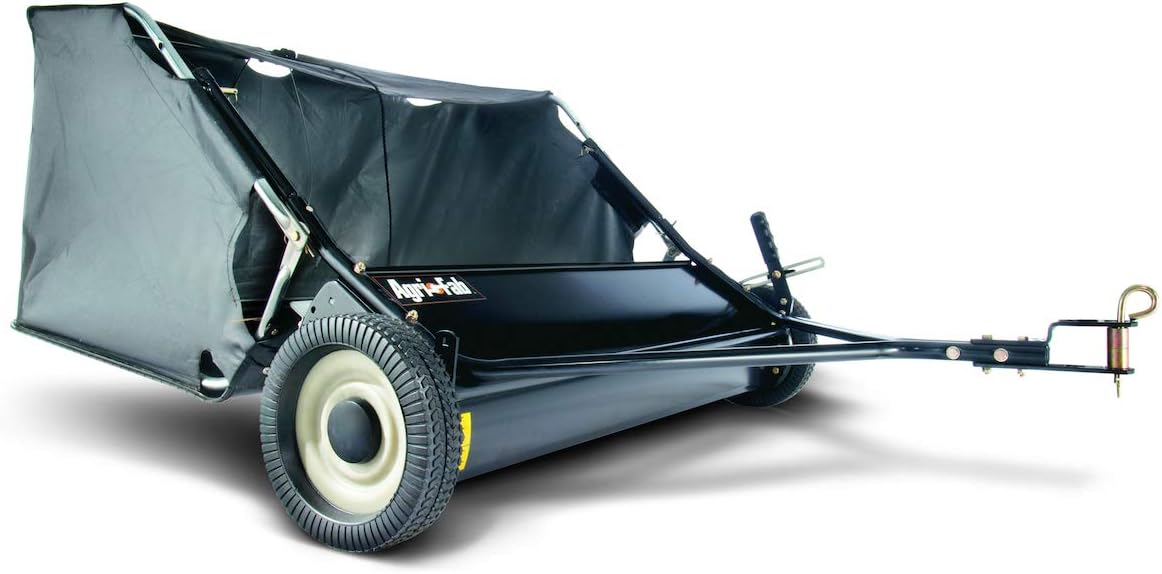
Agri-Fab 45-0320 42-Inch Tow Lawn Sweeper
Best mid-size from a trusted brandThe 45-0320 is the slightly more compact sibling to the 45-0492, and for many yards it is the smarter choice. The 42-inch sweeping path is only a couple of inches narrower, but that small difference can be what lets the unit slip through a standard gate or turn cleanly around a tree ring.
It carries the same Agri-Fab virtues: a simple wheel-driven brush, a dump-from-the-seat hopper and widely available replacement parts. If you want something that will do its job reliably each autumn and spring without much attention, this is a sensible, low-drama choice.
It is particularly well suited to compact lawn tractors with modest drawbar capacity, where a very large, fully loaded hopper might be a lot to pull.
What we like
- Nimbler than 44 to 50-inch models
- Trusted brand with easy parts access
- Suits smaller tractors well
- Simple, dependable mechanism
Keep in mind
- More passes than a 50-inch on big lawns
- Smaller hopper means more dumping
- Still needs a hitch-equipped mower

VEVOR 42-Inch Tow-Behind Lawn Sweeper (12 cu ft)
Best budget-minded tow-behindVEVOR is known for delivering a lot of equipment for the money, and its 42-inch tow-behind follows that formula. You get a 42-inch sweeping width and a 12 cubic foot hopper, which is a sensible capacity for lawns of about half an acre to an acre. It is a good fit if you want the convenience of towing without paying for a big-name label.
With value-priced equipment, the experience often comes down to how you set it up. Take the time to assemble it carefully, set the brush height so the bristles just brush the top of the grass, and confirm the hitch height matches your mower. Done right, it will do the same job as pricier sweepers on ordinary lawn debris.
If you only need a sweeper for a few big cleanups a year, the value case is strong. If you plan to use it constantly on rough ground, you may prefer to spend more.
What we like
- Attractive price for a tow-behind
- 12 cu ft hopper is practical
- 42-inch width balances speed and handling
- Good for occasional seasonal use
Keep in mind
- Take care with assembly and adjustment
- Less brand support history
- Not the pick for punishing daily use
The difference between these two mostly comes down to what you value. If you want known parts availability and a long track record, take the Agri-Fab. If you want to keep the budget lean and you are happy to be a little hands-on with setup, the VEVOR is hard to ignore.
Half an acre to an acre? Compare 42-inch tow-behind sweepers and find the one that fits your mower.
Shop 42-Inch SweepersBest Sweeper and Aerator Combo: Two Lawn Jobs, One Tow Setup
Lawn care runs in seasonal rhythms, and many of the best tasks happen at the same time of year. Autumn is the classic example: leaves come down, the grass is still growing, and the soil is just right for opening up compacted ground. A combo set that pairs a plug aerator with a sweeper lets you run both jobs behind the same tractor, using the same hitch, with far less gear to buy and store than two separate lineups.

Agri-Fab 48-Inch Plug Aerator and 44-Inch Sweeper Combo
Best two-in-one for tractor ownersThis pairing puts a 48-inch plug aerator and a 44-inch sweeper in the same package. A plug aerator pulls small cores of soil out of the lawn, which relieves compaction and lets air, water and nutrients reach the roots. A sweeper then collects the cores, loose thatch and any leaf litter that might sit on top. Between them, they cover two of the most useful yearly lawn tasks.
The big practical benefit is workflow. You aerate first, run the sweeper over the lawn to gather up what has been brought to the surface, then move on to overseeding or fertilizing while the soil is open. If you want to follow that sequence properly, our guide to how to aerate your lawn covers timing, depth and technique, and it fits perfectly with this kit.
The tradeoff is the same as with any combo: you are buying two tools at once, and you need the storage space and a tractor that can handle them. But if you already know you will aerate every year, the value is hard to beat compared with buying separately.
What we like
- Two essential lawn tools in one purchase
- Plug aeration plus sweeping makes a smart autumn routine
- Both attach to the same tractor
- Strong brand with parts support
Keep in mind
- Needs storage space for two attachments
- Requires a tractor with enough towing capacity
- Overkill if you only need sweeping
A fall routine that uses both tools
If the combo sounds like a fit, here is a simple order of operations that makes the most of it. First, mow the lawn a little shorter than usual so the aerator can reach the soil and the sweeper can reach the grass blades. Second, give the soil a good soaking a day or two before, because moist ground lets tines pull clean plugs. Third, run the aerator in two directions for compacted areas. Fourth, sweep. Finally, seed and feed while the soil is open.
The timing of that last step matters a lot. If you plan to overseed, read up on when to overseed your lawn so you do it during the window when grass seed germinates best. And if you want a step-by-step process for fall seeding, our walkthrough on how to overseed a lawn in fall makes it simple.
Good to know: Leaving a few aeration plugs on the lawn is fine, since they break down and return soil to the surface. Sweep them up only if you want a cleaner finish or if you are about to overseed and want the best seed-to-soil contact.
Is a combo worth it?
The value of a combo comes down to use. If you will aerate every year, the pairing saves money and simplifies storage, since the attachments are designed to work with the same tractor. If you would only aerate once in a while, you might be better off renting an aerator and buying a dedicated sweeper. Think honestly about your lawn: heavily trafficked, clay-heavy or compacted lawns benefit most from regular aeration, and for those lawns the combo can be a smart long-term investment.
Want to aerate and sweep with one tractor? See current combo kits and attachments.
View Aerator and Sweeper KitsBest Push Lawn Sweepers for Small and Medium Yards
You do not need a tractor to enjoy a cleaner lawn. Push sweepers are the best answer for typical suburban lots, and the better ones are surprisingly effective on leaves, pine needles and clippings. They are also easy to store: most fold or hang on a garage wall without drama. Here are four push models worth considering, ordered roughly from the strongest overall option to the lightest-duty.

Agri-Fab 45-0218 26-Inch Push Lawn Sweeper
Best push sweeper overallFor most homeowners without a tractor, this is the one to look at first. The 26-inch sweeping width is wide enough to make quick work of an average yard but still comfortable to push and steer. Agri-Fab’s wheel-driven brush design is proven, the hopper is easy to dump, and the handle height can usually be adjusted for comfort.
Where it earns its place is balance. It is not the cheapest push sweeper you can buy, and it is not the widest, but it tends to strike the right compromise between build quality, capacity and ease of use. If you want one push sweeper you can rely on year after year, this is a strong choice.
What we like
- Generous 26-inch sweeping width
- Reliable brand and design
- Comfortable to push and dump
- Good balance of price and quality
Keep in mind
- Can feel like work on very large lawns
- Bigger to store than compact models
- Wet leaves are still a challenge
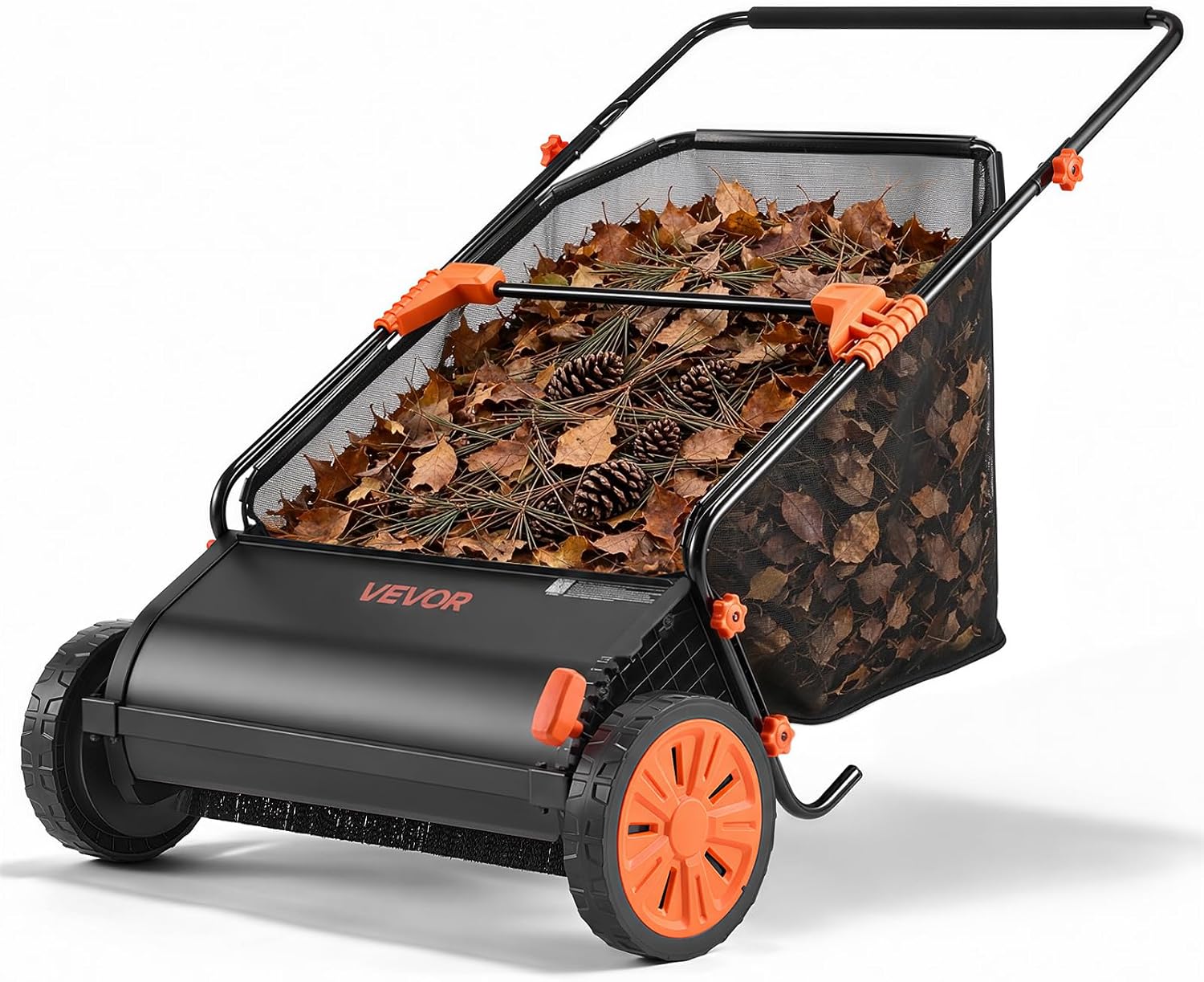
VEVOR 26-Inch Push Lawn Sweeper
Best budget push optionThe VEVOR 26-inch matches the Agri-Fab on sweeping width at a price that is generally friendlier. For a modest yard that sees a few big cleanups a year, that is an appealing proposition. It uses the same simple push-to-sweep principle, and for light to moderate debris, it is a capable machine.
As with most value-focused tools, careful assembly pays off. Make sure the brush is set to touch the grass lightly, not dig in, and check that the hopper attaches securely. If you accept that you may need to fine-tune it, you will likely be happy with the result.
What we like
- 26-inch width at a sensible price
- Simple, easy-to-learn operation
- Light enough to store easily
- Great for occasional use
Keep in mind
- Assembly and adjustment need patience
- May not suit heavy, constant use
- Less long-term parts history than big brands
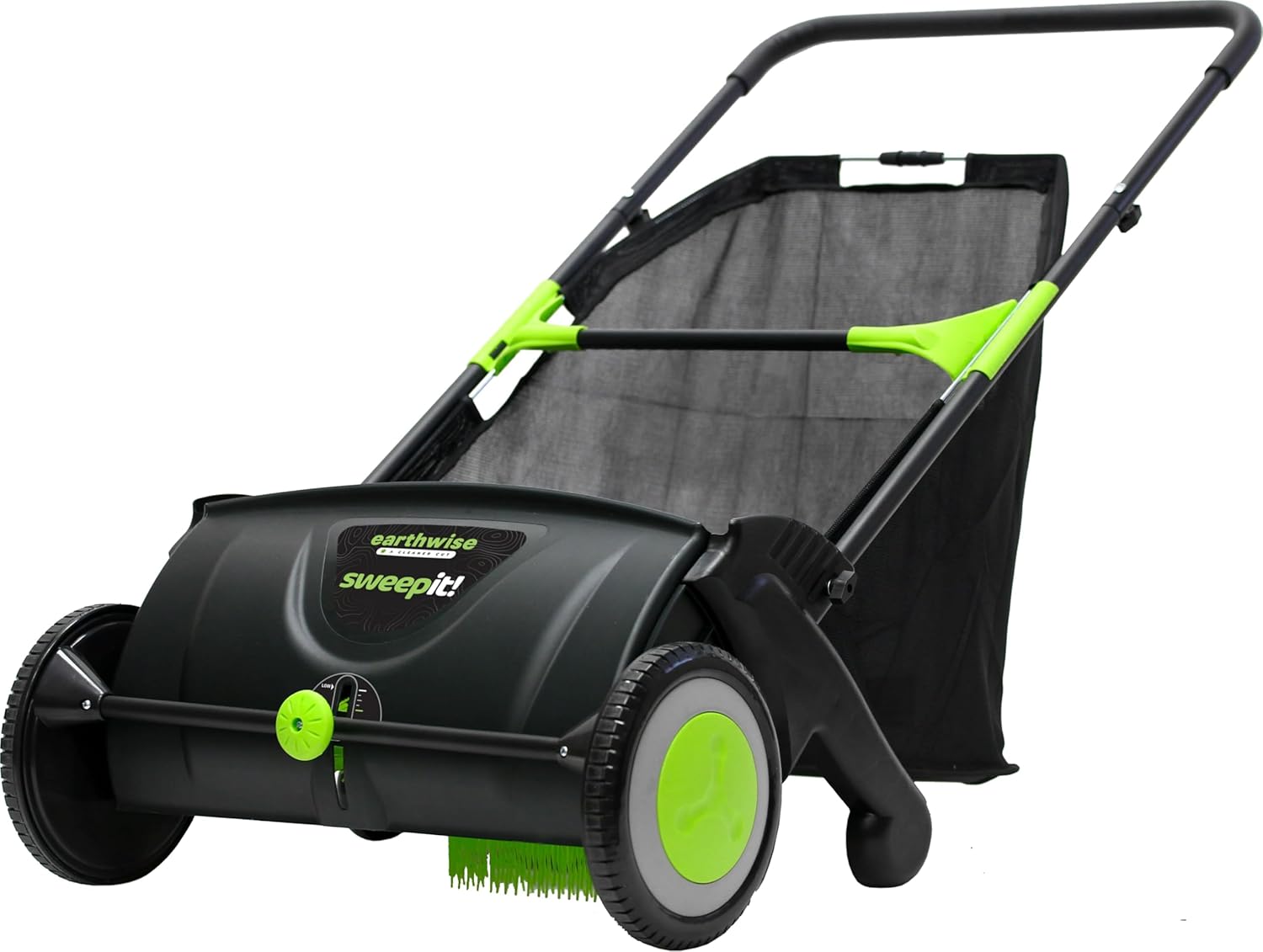
Earthwise LSW70021 21-Inch Push Lawn Sweeper
Best for small spaces and tight gatesEarthwise has long focused on compact, homeowner-friendly yard tools, and the LSW70021 reflects that. At 21 inches, it is narrower than the 26-inch options, which means more passes on open grass. But that smaller footprint is a real advantage in small, cluttered yards, around raised beds, along patios and through narrow side gates.
It is also the sort of tool that is easy to grab for a quick Sunday sweep. Because it is lighter and smaller, it does not feel like a project to get out. If you have a small lawn and mostly want something to deal with leaves, needles and tidy-up work, it is a thoughtful choice.
What we like
- Compact and easy to maneuver
- Fits through narrow gates and tight spots
- Simple to store
- Well-suited to small yards
Keep in mind
- Narrower path means more passes
- Not ideal for large lawns
- Smaller hopper fills quickly in heavy fall
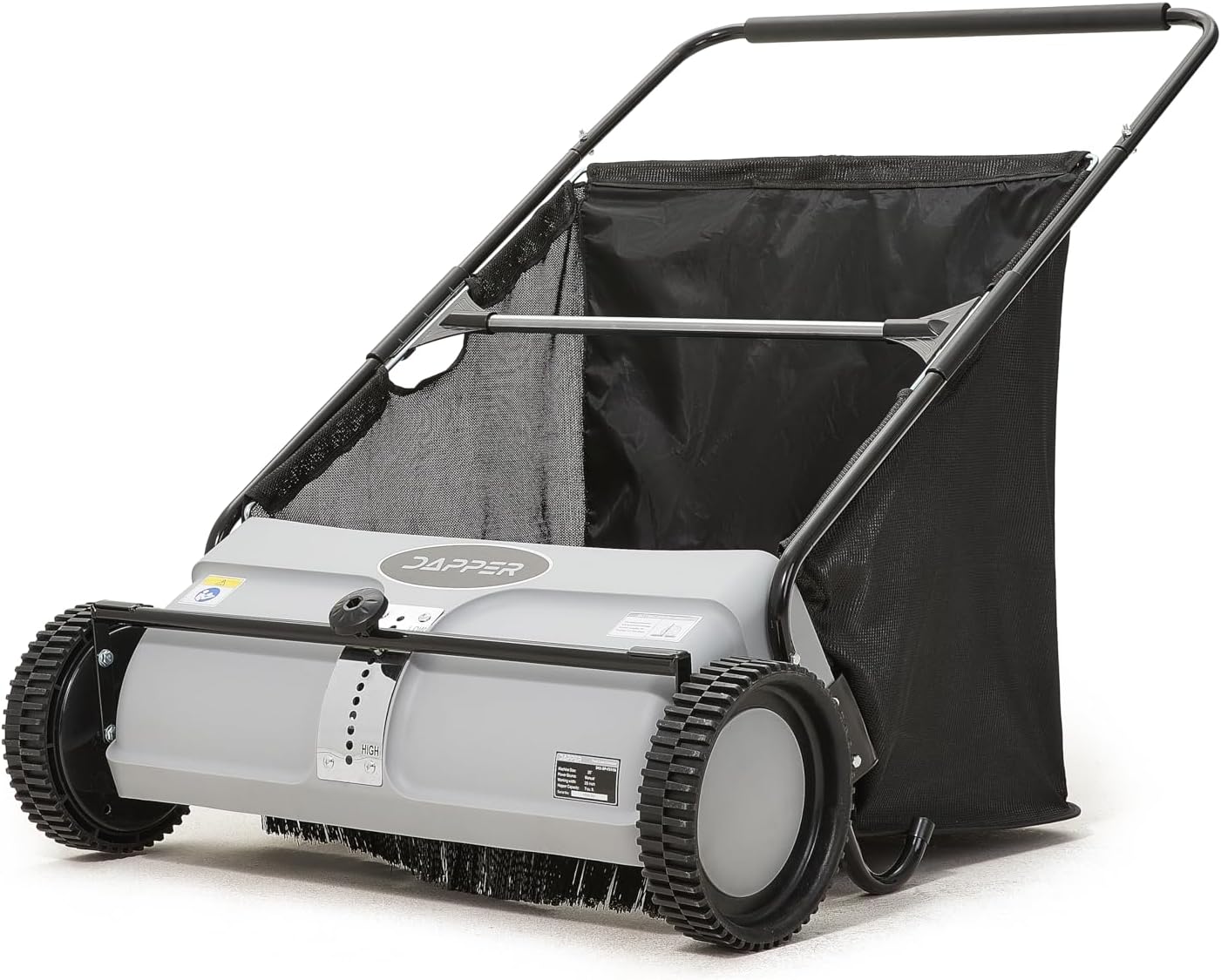
Dapper Supply Push Lawn Sweeper
Light-duty push pickThe Dapper Supply push sweeper is a straightforward option for small yards and light cleanup. It follows the classic push design, with wheels driving brushes into a hopper, and it suits owners who want something simple to bring out for leaf season and put away afterward.
Because specifications such as exact sweeping width and hopper size can vary by listing, it is worth reading the current product page closely before you order, and comparing the numbers with the Agri-Fab and VEVOR push models above. If the dimensions match your needs and the price is right, it can do a perfectly respectable job on a small lawn.
What we like
- Simple, easy-to-use push design
- Practical for small yards
- Easy to store between seasons
Keep in mind
- Check current specs before you buy
- Best for light to moderate debris
- Not meant for large lawns
Pushing tip: Walk at a steady, moderate pace. Rushing makes the brushes spin faster than they can lift debris, and slowing down often picks up noticeably more in a single pass.
No tractor? No problem. Compare push sweepers and pick the width that suits your yard.
Shop Push Sweepers on AmazonHow to Choose the Best Lawn Sweeper: What Really Matters
Spec sheets can feel like a wall of numbers. In practice, only a handful of features change how a sweeper behaves in your yard. Here is what to look at, in roughly the order it matters.
Sweeping width
Width controls how many passes you make. A 50-inch sweeper covers almost twice the ground per pass of a 26-inch push model, and the time saving is dramatic on open lawns. But wider is not always better. A wide unit is harder to turn, harder to store, and may not fit through gates. Measure your access points and think about how many obstacles your yard has before you settle on width.
Hopper capacity
The hopper is the bag that catches debris. A bigger one means fewer stops, which matters most when you have heavy leaf fall. Figures such as the Ohio Steel’s 26 cubic feet or the VEVOR 42-inch’s 12 cubic feet give you a meaningful sense of scale, but remember that a very full hopper is also heavy. For push sweepers, a mid-size hopper with easy dumping is often more practical than a giant one you struggle to lift.
Brush design and height adjustment
The brushes do the real work. Good sweepers let you adjust brush height so the bristles lightly touch the top of the grass: too high, and debris is skipped; too low, and the brushes drag, wear quickly and can stress the turf. Look for simple, tool-free height adjustment, because you will change it with grass height and debris type. Replaceable brush sections or bristle sets are a plus on any model you expect to use for years.
Wheels and drive
The wheels power the brushes, so traction matters. Larger wheels tend to roll more smoothly over bumps and give more consistent brush speed. Check that wheel tread is suitable for lawn use and that bearings or bushings are easy to maintain. Poor traction in damp conditions can lead to wheel slip and weak sweeping.
Hitch and compatibility (tow-behind)
If you are buying a tow-behind, check the hitch carefully. Most use a standard pin-style or drawbar hitch, but mounting heights vary. Check your mower’s hitch point, drawbar length and towing capacity. A full hopper adds weight, and a small tractor on a steep slope will notice it.
Dump mechanism
For tow-behinds, a quick-release lever that you can reach from the seat is a real quality-of-life feature. For push sweepers, check how the hopper detaches and how easy it is to empty into a bag or compost bin.
Build quality and materials
Look for solid steel frames, durable fabrics in the hopper and sturdy fasteners. Hoppers are usually made of heavy fabric or mesh. Mesh lets dust escape, while tighter weaves hold fine debris but can clog. For longevity, the frame and brush mounts matter most, because those take the stress.
Storage footprint
Do not underestimate this. A 50-inch tow-behind is a big object. Make sure you have the space, and that you can get it in and out without moving six other tools first. Many push models can be hung on a garage wall.
Budget
Sweepers are not usually expensive compared with other lawn equipment, but price differences are real. The strongest value is usually the model that matches your lawn size and tractor. Spending more for a wide, heavy-duty model on a small lawn wastes money, and cheaping out on a model that is too small for a large lawn costs you time every season.
| Feature | What to look for | Why it matters |
|---|---|---|
| Sweeping width | 26 inches for push, 42 to 50 inches for tow | Fewer passes, faster cleanup |
| Hopper size | Match to debris volume and your lifting ability | Fewer stops to dump |
| Brush height | Tool-free, multi-position adjustment | Better pickup, less wear on turf |
| Wheels | Larger, grippy, easy to maintain | Consistent brush speed |
| Hitch | Fits your mower or tractor | Safe, secure towing |
| Build | Steel frame, heavy hopper fabric | Years of seasonal use |
Common buying mistakes to avoid
Most regrets after buying a sweeper come from a short list of avoidable errors. The first is buying too wide. A 50-inch unit looks efficient on paper, but if you cannot get it through the gate or around your trees, you will spend more time maneuvering than sweeping. The second is buying too small, for example a narrow push model for a large lot, which turns a one-hour job into a whole afternoon.
The third mistake is ignoring the hitch. Tow-behind sweepers are only useful if they connect to your mower safely, so confirm the hitch type and height before you order. The fourth is forgetting storage. Many people only realize after delivery that the sweeper does not fit where they planned to keep it. The fifth is expecting miracles on wet, matted leaves. No sweeper handles those well, so plan your cleanup for dry conditions.
Finally, do not assume the most expensive model is the best for you. A good match for your lawn size, mower and storage will beat an oversized, heavy-duty machine you do not need. Be realistic about how often you will use it and how much debris you actually deal with.
Slopes, bumps and uneven ground
If your lawn is hilly or bumpy, give extra thought to wheel size and weight. Larger wheels roll over uneven ground more smoothly, and a lighter machine is easier to control on a slope. With tow-behinds, sweep across slopes carefully and keep an eye on the weight of a full hopper. On very rough ground, brushes can bounce and skip debris, so slow down and consider raising the brush slightly so it does not dig into humps.
Know what you need? Filter sweepers by width, type and price on Amazon.
Find Your Lawn SweeperLawn Sweeper vs Rake, Leaf Blower, Mulching Mower and Lawn Vacuum
A sweeper is not the only way to deal with leaves and lawn debris, and it is not always the best. The honest answer depends on how much debris you have, how big your lawn is, what you already own and how much you value your weekends. Here is how the main alternatives stack up.
Sweeper vs rake
A rake is cheap, quiet and works anywhere, including under shrubs, along fences and on slopes where a wheeled tool struggles. It is also slow, hard on the back and shoulders, and it still leaves you with a pile that has to be bagged or tarped. A sweeper collects as it goes, so there is no second step. For anything bigger than a small patch of lawn, the sweeper wins on time and effort. For tight spots and beds, the rake still earns its place as a partner tool.
Sweeper vs leaf blower
Blowers are fast at moving leaves from one place to another, and they are excellent for hard surfaces, gutters and beds. But on a lawn they do not collect anything; you still need to gather the pile. They are loud, they use fuel or battery, and they scatter debris, dust and seeds. A sweeper is quieter, uses no fuel, and finishes the job in one pass. Many people use both: a blower to flush leaves out of beds and corners, then a sweeper to pick up what ends up on the lawn.
Sweeper vs mulching mower
A mulching mower chops leaves into small pieces that fall into the turf and break down, which can be a great low-effort option when leaf cover is light. If the layer is thin enough that you can still see grass through it, mulching is hard to beat. Once the layer gets thick, though, it can smother the lawn and clog the mower. Sweepers are better for heavy drops, pine needles, twigs and anything the mower cannot chew up. Many owners mulch light leaf fall in early autumn and sweep when the heavy drop arrives.
Sweeper vs lawn vacuum
Powered lawn vacuums and mower bagging attachments suck up leaves and chop them in the process. They are very effective, particularly with wet or mixed debris, but they come with engine or motor maintenance, fuel or battery costs, noise and a higher price. A sweeper trades some of that power for simplicity: no engine, no fuel and very little to go wrong.
| Tool | Strength | Weakness | Best for |
|---|---|---|---|
| Lawn sweeper | Collects as it goes, no fuel or power | Struggles with wet, matted leaves | Dry leaves, needles, clippings on open lawns |
| Rake | Cheap, goes anywhere | Slow and tiring | Tight beds and slopes |
| Leaf blower | Fast, versatile | Noisy, does not collect | Hard surfaces and beds |
| Mulching mower | Recycles light leaf cover | Poor with heavy layers | Light autumn fall |
| Lawn vacuum | Powerful, handles wet material | Costly, needs maintenance | Large, mixed debris loads |
There is no single right answer. For plenty of homeowners, a sweeper plus a rake for the tricky spots covers nearly everything. Others pair a blower with a sweeper and never touch a tarp again.
Building a cleanup kit? Pair your sweeper with a sturdy lawn rake for beds, borders and tight corners.
Shop Lawn Rakes on AmazonHow to Get the Best Results From Your Lawn Sweeper
A sweeper is simple, but a few habits make the difference between a clean lawn and a frustrating afternoon. Most disappointing results come from the same handful of mistakes, and all of them are easy to avoid.
Start with a dry lawn
This is the single biggest factor. Dry leaves are light and lift readily into the hopper. Wet leaves are heavy, flat and stuck to the grass, and brushes simply glide over them. If the forecast allows, wait for a dry afternoon. Mid-day, after the dew has burned off, is usually the best window.
Mow first, then sweep
Short grass lets the brush reach the turf surface and flick debris upward. If you are about to mow anyway, do it before sweeping. Timing the last few mows of the year matters too, so if you are not sure when to hang up the mower for the season, our guide on when to stop mowing your lawn will help you plan the final cuts around leaf drop.
Set the brush height properly
Aim for bristles that just touch the tops of the grass blades. Too high and the brush skips debris; too low and it drags, wears quickly and scuffs the turf. Adjust for conditions: slightly lower for clippings and fine debris, slightly higher on thin or new grass. Check the setting after the first pass and fine-tune.
Overlap your passes
Like mowing, sweeping works best in overlapping lanes. Overlapping by a few inches avoids stripes of uncollected debris. Work in straight lines where you can, and finish by sweeping across your original direction if you see leftovers.
Do not overload the hopper
A full hopper stops the brush from throwing debris in, and it can spill leaves back onto the lawn. Dump before it is completely full, especially with damp material. On a tow-behind, watch the weight on slopes and take hills at a steady, moderate speed.
Slow down
Speed is the enemy of good pickup. A moderate walking pace for push models, and a gentle tractor speed for tow-behinds, gives the brush time to lift debris. Racing along leaves a trail of missed leaves behind you.
Fit sweeping into your seasonal routine
Sweepers are not just for the autumn leaf drop. They also help in spring, clearing winter debris, twigs and dead grass before the season starts. Used after dethatching or aerating, they collect what the other tool lifts. And after seeding or feeding they are best left in the shed until the new grass is established.
Speaking of feeding, timing matters if you want a thicker lawn. If you are planning a fertilizer program alongside your cleanup, check out when to fertilize your lawn to line up the schedule with your sweeping.
Compost bonus: Swept leaves are fantastic compost fodder. Mix them with green material such as grass clippings and kitchen scraps to keep the pile balanced, or store them in a corner bin to make leaf mold for the garden.
Sample cleanup plans by yard size
Small yard with a push sweeper. Choose a dry afternoon, mow if needed, then sweep the open lawn in overlapping lanes. Empty the hopper at the compost bin or into leaf bags as it fills. Use a rake for corners and beds, then finish with one quick extra pass across the main lawn in the opposite direction.
Medium yard with a push sweeper. Split the yard into zones, such as front, side and back, and clear one at a time so a full hopper never has far to travel. Take short breaks between zones. If the debris layer is heavy, sweep twice, with a few days between passes, rather than trying to clear it all in one go.
Large lawn with a tow-behind. Work in long, straight passes, overlapping a few inches. Use the seat-mounted dump lever near your pile or compost area so you are not driving across the whole property. Keep your speed steady, especially on slopes, and stop to clear the brush if it clogs.
On any size of yard, it helps to remove sticks, toys and hoses before you start. A single stray hose caught in the brush will stop the job quickly.
Make cleanup a one-day job. Check the latest lawn sweeper deals and pick yours today.
Compare Lawn SweepersLawn Sweeper Maintenance, Storage and Seasonal Care
One of the best things about a lawn sweeper is that it asks very little of you. There is no oil to change and no spark plug to replace. But a little attention at the end of each use and each season will keep the machine working for many years.
After every use
- Empty the hopper completely. Damp debris left inside will mildew and rot the fabric.
- Clear the brush. Pull out wrapped twine, vines, grass and any tangled material so the bristles can spin freely.
- Knock off caked-on grass. A putty knife or stiff brush works well on dried clippings.
- Look it over quickly. Check for loose fasteners, bent tines and anything that looks out of place.
Seasonal checks
- Tighten hardware. Vibration works nuts and bolts loose over time, so a quick pass with a wrench at the start of each season pays off.
- Inspect the brush. Worn, shortened bristles lose sweeping power. If the brush is noticeably worn, adjust it down or replace the bristle set if the design allows.
- Grease moving parts. Apply a light grease or lubricant to bearings, axles and pivot points as the manual recommends.
- Check the tires. If your sweeper has pneumatic tires, keep them properly inflated, since uneven pressure affects brush speed and sweeping consistency.
- Inspect the hopper. Look for rips, loose seams and failing fasteners. Small tears can often be patched or stitched before they grow.
Winter storage
Store your sweeper clean and dry, indoors if you can. Direct sun degrades hopper fabric, and moisture rusts steel. If it must live outside, use a breathable cover rather than a plastic tarp that traps condensation. Take the weight off the brush if you can, for example by hanging a push model on a wall, because bristles that sit flat for months can bend and lose their spring.
It is a good time to give the rest of your equipment the same attention. If your mower is also going away for the season, our guide to how to winterize a lawn mower covers fuel, blades and batteries so everything starts easily in spring.
Handling wear and parts
Brushes, hopper fabric and hardware are the main wear items. Established brands like Agri-Fab tend to make replacement parts easier to track down. With value brands, it is worth checking what is available before you buy, and keeping a few spare fasteners on hand. A well-kept sweeper commonly lasts for many seasons, and that is part of why the category has such a loyal following.
| When | Task | Time needed |
|---|---|---|
| After each use | Empty hopper, clear brush, wipe down | 5 to 10 minutes |
| Start of season | Tighten hardware, check tires, lubricate | 15 to 20 minutes |
| Mid-season | Inspect brush wear and hopper seams | 10 minutes |
| End of season | Deep clean, repair, store dry | 20 to 30 minutes |
Why small habits add up
Equipment that gets used once or twice a year tends to suffer from neglect rather than overuse. Wet leaves left in the hopper rot the fabric. Rust creeps into unprotected hardware. Mice and insects find soft places to nest. None of these things take long to prevent, but they are easy to forget when the season ends. Setting a reminder to give the sweeper ten minutes of attention at the end of leaf season is the best insurance you can buy.
Need a cover or spare parts? Protect your sweeper between seasons with a proper equipment cover.
Shop Sweeper Parts and CoversLawn Sweeper Troubleshooting: Fixing the Most Common Problems
Even a simple machine can misbehave now and then. The good news is that almost every sweeper problem has one of a few causes, and almost all of them are fixed in minutes with basic tools.
It is leaving leaves behind
The usual culprits are brush height, speed and wetness. If the bristles are not touching the grass, raise the pickup by lowering the brush. If you are moving too fast, slow down. If the leaves are damp and matted, wait for drier weather or go over the area a second time in a different direction. Worn bristles can also cause skipped debris, so check the brush length.
The brush is not turning
First check for something jammed around the brush: string, vine or wire. Then inspect the drive, which on most models is a belt, chain or gear system connecting the wheels to the brush. Look for a slipped or damaged belt, loose sprocket or missing pin. Make sure the wheels are firmly attached and spinning with the sweeper moving forward.
The hopper is not filling evenly
If debris piles up on one side, the unit may be sitting unevenly or the brush may be adjusted unevenly. Check the tire pressure on both sides and make sure the brush height is the same at each end. On a tow-behind, check the hitch height so the sweeper runs level.
It scalps or tears the lawn
That means the brush is set too low or the lawn is very thin. Raise the sweeper so the bristles just kiss the tops of the grass. On new or recovering grass, skip sweeping until the lawn is established and has been through a few mowings.
The hopper keeps dumping debris back out
Usually the hopper is overfull or the fabric is not seated properly. Empty it more often and make sure the frame and fasteners are tight. On a push sweeper, check that the hopper clips are fully engaged.
It is hard to push or tow
A full, heavy hopper is the first thing to check. Next, look at the tires and brush: too much brush contact increases drag. A brush dug into the soil makes pushing a chore. For tow-behinds on slopes, slow down and make sure your tractor has enough capacity for the load.
Noise, wobble or vibration
Almost always a loose fastener or worn bearing. Stop, tighten hardware, check the wheel mounts and add lubricant to any dry bearings. If a wheel wobbles even when tight, the axle or bushing may need replacing.
Safety note: Before touching the brush or drive system, stop the tractor, set the brake and take the key out. For push models, simply stop and tip the unit away from you. Never put hands near moving brushes.
Time for an upgrade? If your current sweeper has seen better days, compare newer models and replacement options.
See Top-Rated Lawn SweepersLawn Sweeper FAQs
What is the best lawn sweeper overall?
It depends on your lawn. For large properties with a tractor, the Ohio Steel 50-inch with its 26 cubic foot hopper and the Agri-Fab 45-0492 are standout choices. For small and medium yards without a tractor, the Agri-Fab 45-0218 26-inch push sweeper is our top pick for its balance of width, build and ease of use. The best sweeper is the one that matches your yard size, your equipment and your storage space.
Do lawn sweepers really work?
Yes, within their limits. On dry leaves, pine needles, twigs and clippings, a properly adjusted sweeper does an excellent job and saves a lot of effort compared with raking. They are less effective on wet, matted leaves and very long grass. If you want a closer look at the real-world results, our article on whether lawn sweepers work goes through it in detail.
Should I buy a push or a tow-behind sweeper?
If you have a lawn tractor or ride-on mower with a hitch and more than about half an acre, a tow-behind will save you substantial time. For smaller lawns, or if you do not own a towing machine, a push sweeper is the sensible, affordable choice. Push sweepers are also easier to store and handle tight spaces better, while tow-behinds win on width and hopper size.
What size lawn sweeper do I need?
Think in terms of passes. A 21 to 26-inch push sweeper suits lawns up to roughly a quarter acre. For half an acre or more, step up to a 42 to 50-inch tow-behind. Width also needs to fit your gates and storage, so measure those before choosing. If your yard has a lot of obstacles, a slightly narrower unit may actually finish faster than a wide one that has to maneuver around everything.
Can a lawn sweeper pick up wet leaves?
Poorly. Wet leaves are heavy and cling to the turf, so the brushes tend to slide over the top. You may pick up some, but results are inconsistent and the hopper gets heavy quickly. For the best performance, wait for the lawn to dry out. If you must deal with wet leaves, sweep slowly, lower the brush slightly, and be ready to make a second pass.
Will a lawn sweeper damage my grass?
Not if it is set up correctly. Damage usually comes from setting the brush too low so it drags across the turf, or from sweeping very thin or newly seeded grass. Keep the bristles lightly touching the tops of the grass blades, and avoid sweeping young lawns until they are established. A properly adjusted sweeper is gentle on healthy turf.
Can I use a lawn sweeper for pine needles and twigs?
Yes, and this is one of the places sweepers truly shine. Pine needles and small twigs are awkward to rake and often ignored by mulching mowers, but a sweeper lifts them well when the lawn is dry. Larger branches should be removed by hand first, because they can jam the brush or damage the hopper.
Can I use a sweeper for grass clippings?
You can, and it works nicely when you have cut the lawn with the side discharge or a mower that is not bagging. Clippings are best collected while still dry. Be careful not to overload the hopper, since fresh clippings are dense and heavy. Collected clippings are good compost material, though thick layers should be mixed with brown material to avoid a slimy pile.
What can I tow a lawn sweeper with?
Most tow-behind sweepers are designed for lawn tractors, garden tractors, zero-turn mowers with a hitch and utility vehicles such as ATVs or UTVs. Check your machine’s hitch type, hitch height and towing capacity against the sweeper’s requirements. A full hopper adds weight, so very small mowers or steep slopes call for extra caution.
When is the best time of year to use a lawn sweeper?
Autumn is the main season, once most of the leaves have fallen and the lawn is dry. Many people sweep a second time in spring to clear winter debris, twigs and dead grass. You can also use a sweeper after dethatching or aeration to collect what has been brought up. If you plan to overseed, our guides on timing overseeding and overseeding in fall show how sweeping fits into the sequence.
How do I empty and clean a lawn sweeper?
On tow-behinds, a release handle within reach of the seat tips or opens the hopper, so you can dump in a compost area without getting off. On push models, you usually detach or lift the hopper and empty it into a bag, bin or pile. Afterward, clear tangled material from the brush, knock off dried grass and let the hopper dry before storing it to prevent mildew.
How long does a lawn sweeper last?
With simple care, many sweepers last for many seasons. The parts that wear first are the brush bristles, hopper fabric and fasteners. Emptying the hopper after each use, keeping everything dry in storage and tightening hardware each season go a long way. Choosing a model from a brand with easily available parts also makes it easier to keep it running.
Final Verdict: Which Lawn Sweeper Should You Buy?
A lawn sweeper will not transform a neglected yard on its own, but it removes the single most tedious chore of the lawn year and does it without fuel, cords or fuss. The key is matching the machine to the ground you actually have to cover.
If you are working with a large lawn and a tractor, start with the Ohio Steel 50-inch for its huge 26 cubic foot hopper and wide path, or choose the Agri-Fab 45-0492 if you prefer a well-known brand and a more manageable 44-inch width. Value hunters should look hard at the AllFitHD 50-inch, and owners of compact tractors or mid-size lawns will be well served by the Agri-Fab 45-0320 or the VEVOR 42-inch with its 12 cubic foot hopper. If you already plan to aerate each fall, the Agri-Fab aerator and sweeper combo makes two seasonal jobs far easier.
For everyone without a towing machine, the Agri-Fab 45-0218 is our favorite push sweeper thanks to its generous 26-inch width, with the VEVOR 26-inch as the budget alternative. If your yard is small and full of tight turns, the Earthwise 21-inch fits the space best, and the Dapper Supply push model is a simple, light-duty option worth checking against the others.
Whichever you choose, set the brush height carefully, sweep when the lawn is dry, empty the hopper before it overflows and store the machine clean. Do that, and your sweeper will give you cleaner autumns and easier springs for years. Your back will thank you too.
Ready to clear your lawn the easy way? Check today’s prices on the best lawn sweepers and pick the one that fits your yard.
Shop the Best Lawn Sweepers on AmazonYou May Also Like
Keep your lawn looking its best with these related guides from Lawn Care Hacks.