
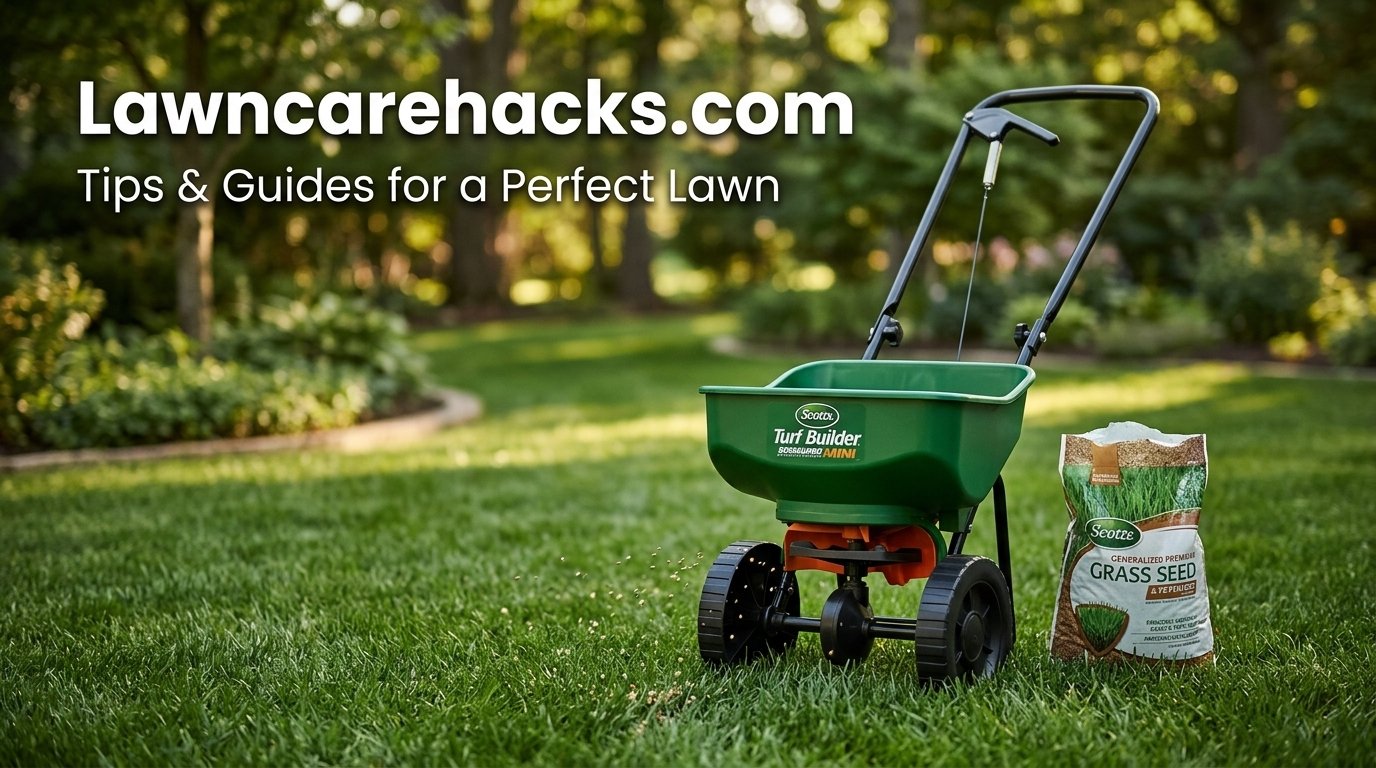
Best Broadcast Spreaders: 11 Top Picks for Every Lawn Size
From tiny front yards to sprawling acreage, the right spreader turns a bag of fertilizer or grass seed into an even, professional-looking feed. Here are the models worth pushing, pulling, or strapping on this season.
Why a Good Broadcast Spreader Is the Best Money You’ll Spend on Your Lawn
There’s a reason professional lawn crews never hand-spread anything. Granular fertilizer and grass seed are wildly unforgiving when applied by hand — you get dense patches that burn, thin streaks that starve, and half the bag on the sidewalk. A broadcast spreader solves that in one move: it flings material in a wide, even fan as you walk, so every square foot gets the same dose.
The payoff is visible. Even feeding produces even color. Even seeding produces even density. And because the spreader meters product out through an adjustable opening instead of a shovel, you actually use less material to get a better result. That single fact is why a spreader pays for itself quickly, whether you’re fertilizing four times a season or overhauling a tired, thin lawn.
What surprises most first-time buyers is how many different shapes a broadcast spreader can take. There are compact push models built for a quarter-acre suburban lot, heavy-duty walk-behinds with big hoppers that hold enough for an acre in one fill, tow-behind units that hang off a riding mower or an ATV, chest-mount styles that keep both hands free on slopes and rough ground, and small cordless handhelds made for sidewalk strips and spot repairs. They all do the same job. They don’t all do it the same way.
That’s what this guide is for. We’ve put together a shortlist of eleven spreaders that cover the full range of lawn sizes, budgets, and working styles, and we’ve written up what each one is genuinely good at — not just what the box says. You’ll find a quick comparison table up front if you want answers fast, detailed reviews for every model further down, and a calibration section at the end that will improve the results of any spreader you own.
Short on time? For most suburban lawns, a compact push spreader with an edge-control shield is the sweet spot. If your property runs past half an acre, step up in hopper capacity — refilling is the number one complaint people have about undersized spreaders.
A quick note on how we chose. We focused on the things that actually determine whether a spreader earns a permanent spot in the garage: how evenly it throws material, how well it keeps granules off your driveway and flower beds, how much it holds before you stop to refill, how smoothly it rolls over real-world turf, and how much work it takes to clean and store. Spec sheets matter, but the way a spreader behaves mid-pass matters more.
Before you spread anything this season, it’s also worth knowing what your lawn actually needs. Timing and application go hand in hand — our guides on when to fertilize your lawn and how to aerate a lawn pair perfectly with the spreader tips below, because the best spreader in the world can’t fix a badly timed application.
Quick Comparison: Our Top Picks
Every spreader in this guide is listed below, ranked by the kind of job it does best. Scroll the table sideways on a phone to see specs and price links.
Swipe to see more →
| # | Product | Product Name & Best For | Key Specs | Verdict | Where to Buy |
|---|---|---|---|---|---|
| 1Top Pick | 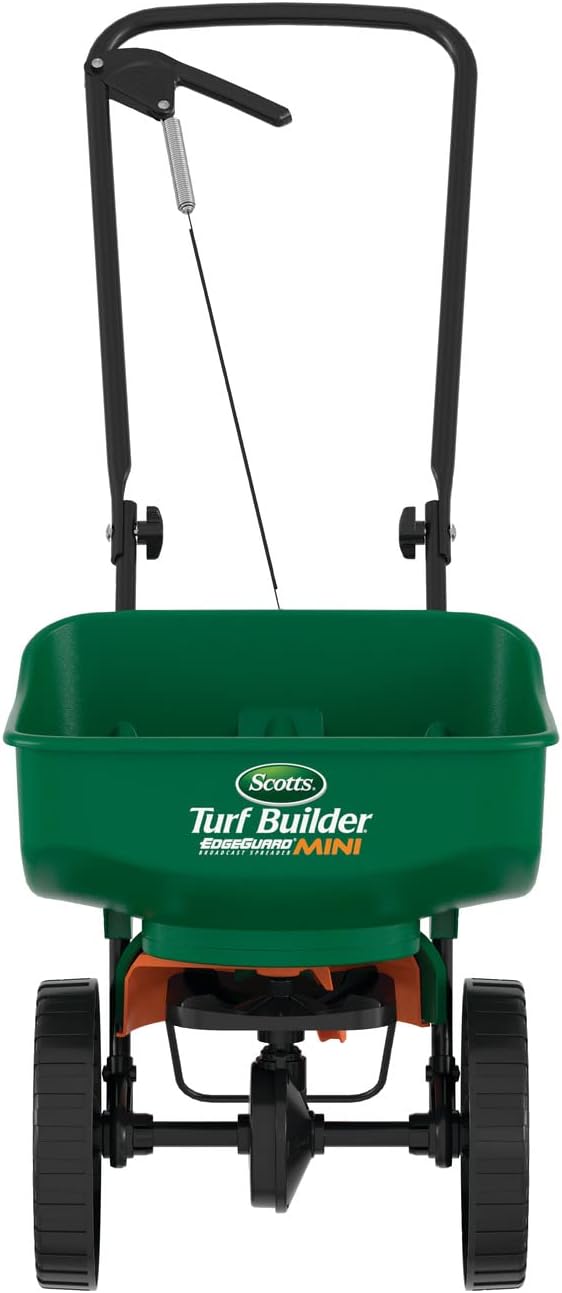 |
Scotts Turf Builder EdgeGuard Mini Broadcast SpreaderBest Overall for Small to Mid-Size Lawns |
|
The one most homeowners should buy — controlled, tidy, and beginner-proof. | Check Price on Amazon |
| 2 |  |
EarthWay 2050P 80 lb Broadcast SpreaderBest for Large Lawns |
|
Serious capacity with a rugged, commercial feel — fewer stops, cleaner pattern. | Check Price on Amazon |
| 3 | |
Agri-Fab 45-0462 130 lb Push Broadcast SpreaderBest High-Capacity Push Spreader |
|
When a walk-behind is the biggest job you’ll ever need it to do. | Check Price on Amazon |
| 4 |  |
SOLO 421 Chest-Mount SpreaderBest for Slopes & Tight Terrain |
|
Goes where wheels can’t — hills, rough ground, and narrow side yards. | Check Price on Amazon |
| 5 |  |
Chapin 8400C Professional Turf SpreaderBest Professional-Grade |
|
A workhorse for anyone spreading product week after week. | Check Price on Amazon |
| 6 |  |
Buyers Products ATVS100 ATV/UTV Broadcast SpreaderBest for Acreage & Trail Work |
|
Covers ground faster than anything you can push or pull by hand. | Check Price on Amazon |
| 7 |  |
VEVOR 60 lb Walk-Behind Broadcast SpreaderBest Value Walk-Behind |
|
The middle ground most lawns actually need, at a friendly price. | Check Price on Amazon |
| 8 |  |
Titan Attachments 50 lb Broadcast SpreaderBest Mid-Size All-Rounder |
|
Compact enough to live in a shed, big enough to stop babysitting refills. | Check Price on Amazon |
| 9 |  |
Craftsman 110 lb Pull-Behind Broadcast SpreaderBest Pull-Behind for Riding Mowers |
|
Let the mower do the walking while you handle the spreading. | Check Price on Amazon |
| 10 |  |
Uniqwamo 18V Cordless Handheld SpreaderBest Cordless Handheld |
|
Perfect for sidewalks, borders, and quick spot applications. | Check Price on Amazon |
| 11 |  |
Amazon Basics Fertilizer SpreaderBest Budget Option |
|
No-frills and honest — ideal if you spread a few times a year. | Check Price on Amazon |
What to Look For in a Broadcast Spreader Before You Buy
Choosing a spreader comes down to a handful of decisions, and once you understand them, the shortlist usually narrows itself. Here’s what genuinely matters, in the order it tends to matter.
Start with the type, not the brand
There are four broad families. Push or walk-behind spreaders are the default for most homeowners — you walk behind them and they broadcast from a spinning plate near the base. Tow-behind spreaders mount to a riding mower, lawn tractor, or garden tractor and are built for size. ATV/UTV spreaders attach to a utility vehicle and cover acreage at driving speed. Handheld and chest-mount spreaders trade capacity for agility, and they shine on slopes, in narrow side yards, and for quick touch-up jobs.
If you’re fertilizing a normal suburban lawn a few times a season, a push model is almost certainly right. If you dread the thought of pushing anything, or your property is measured in acres rather than square feet, jump to a tow-behind. If your yard has hills, gates, or awkward corners, a chest-mount style is worth a serious look.
Match capacity to your property
Hopper capacity is the number one thing people underestimate. A small hopper on a big lawn means constant stopping, refilling, and restarting — and every restart is a chance to overlap wrong and create a stripe. As a rough guide, compact spreaders suit small to mid-size lawns, mid-range models in the 50 to 60 lb class handle medium to large yards comfortably, and heavy units in the 80 to 130 lb range exist for large properties and anyone who hates refilling.
Remember that a full hopper also adds weight. Big capacity is wonderful on flat ground and a workout on hills. If your lawn is steep, a lighter spreader or a chest-mount style may actually get the job done faster.
Edge control is the feature you’ll appreciate most
Nothing ruins a Saturday like sweeping fertilizer granules off the driveway. A deflector or edge-control shield blocks the outward throw on one side so you can run right along a walkway, garden bed, or fence line without overspray. Some spreaders include this as a built-in guard; others leave it to your technique. If your lawn is bordered by hardscape, prioritize it.
Flow control and calibration
The opening at the bottom of the hopper meters how much product drops onto the spinning plate. A dial or lever that adjusts cleanly and holds its setting is worth more than any other single detail. Even the best spreader needs to be calibrated to the product you’re using — granule size varies between fertilizer, seed, and ice melt, and the setting on the dial is a starting point, not gospel. We cover a simple calibration routine in the maintenance section below.
Wheels, frame, and how it rolls
Wide, well-gripped wheels keep the spreader tracking straight and prevent the tires from chewing up soft turf. A frame that feels solid at the handle matters too — a wobbly spreader wobbles your spread pattern. For tow-behind models, look at how the unit sits behind the vehicle and how easily it connects and disconnects.
Cleaning and storage
Granular products attract moisture, and anything left in a hopper can clump. The best-designed spreaders open up easily for a rinse and dry, and fold or stand compactly for storage. A spreader that’s annoying to clean is a spreader you’ll neglect, and neglected spreaders clog at exactly the wrong moment. Pair your spreader routine with the wider seasonal plan in our guide to the best lawn aerators — aeration and feeding go together beautifully.
Push & Walk-Behind Broadcast Spreaders: The Everyday Workhorses
Walk-behind spreaders are the heart of this guide, and for good reason: they’re the tool that fits the largest number of lawns. You set the flow, walk a steady pace, and the spinning plate throws material out to both sides in a fan that gradually blends as you overlap each pass. Once the rhythm clicks, you can feed an entire lawn in the time it takes to mow half of it.
The five models below cover the range from compact and edge-conscious to genuinely large-capacity. If you want a quick side-by-side before reading the full reviews, start here.
Swipe to see more →
| Product | Best For | Capacity & Style | Standout Point | Where to Buy |
|---|---|---|---|---|
|
Scotts Turf Builder EdgeGuard MiniSmall to mid-size lawns | Compact push design | Edge-control shield keeps granules on the grass | Check Price on Amazon |
|
EarthWay 2050P 80 lbLarge lawns | 80 lb push design | Rugged, professional-grade build quality | Check Price on Amazon |
|
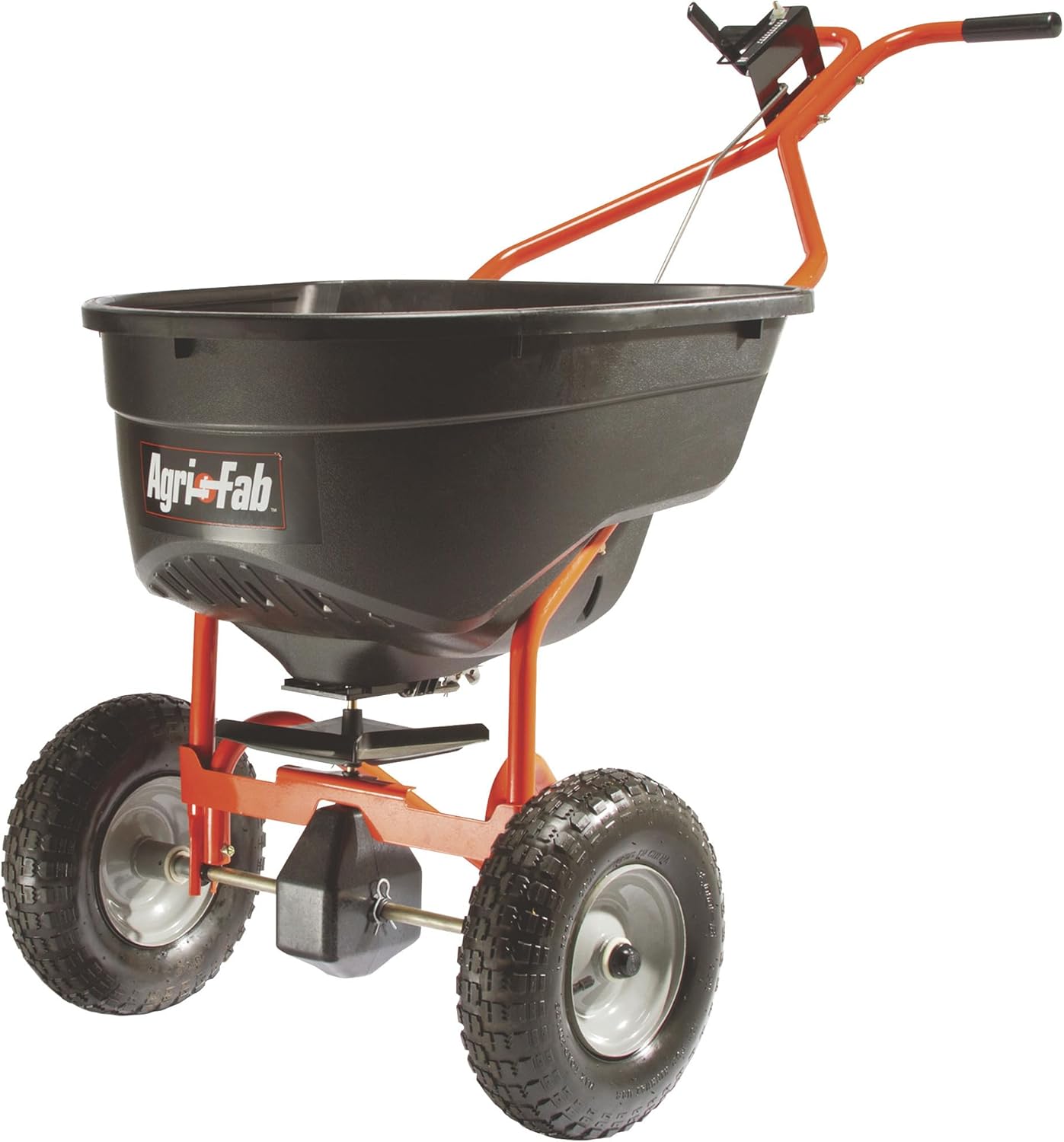
Agri-Fab 45-0462 130 lbBiggest push capacity | 130 lb push design | Fewer refills than anything else you can push | Check Price on Amazon |
|
VEVOR 60 lb Walk-BehindBest value | 60 lb walk-behind | Mid-range capacity without the premium price | Check Price on Amazon |
|
Titan Attachments 50 lbMedium lawns | 50 lb walk-behind | Compact footprint, versatile material use | Check Price on Amazon |
Choosing between them mostly comes down to two questions. How much lawn are you covering in one session, and how close do you need to spread to edges? If the answer to the first is “a lot,” lean toward the 80 to 130 lb class. If the answer to the second is “right along the driveway,” prioritize an edge-control feature. Everything else — wheel style, handle comfort, hopper shape — is secondary to those two points.
Scotts Turf Builder EdgeGuard Mini Broadcast Spreader
Scotts Turf Builder EdgeGuard Mini Broadcast Spreader
This is the spreader we’d hand to someone buying their first one. It’s compact enough to steer around flower beds and gate posts without a fight, and the EdgeGuard deflector does exactly what its name promises — it blocks the outward throw on one side so granules land on the lawn instead of on your patio stones.
For the average suburban lot, that combination of a small footprint and controlled edges is everything. Most people’s spreading problems aren’t about the middle of the lawn — the middle takes care of itself as long as you walk a steady pace and overlap each pass. The problems live at the borders, where a standard spreader happily throws expensive fertilizer into the street.
Key features
- Edge-control deflector shield — keeps material where you want it along driveways, sidewalks, and garden beds.
- Compact push design — easy to maneuver around landscaping, sprinkler heads, and tight corners.
- Simple flow adjustment — a straightforward control for opening and closing the hopper gate.
- Manageable weight — light enough to lift into a shed or hang on a wall hook between uses.
- Beginner-friendly pattern — forgiving enough that a first-time user gets even coverage without a learning curve.
What we like
- Deflector shield is a genuine driveway saver
- Compact size stores easily in a small garage
- Intuitive controls — no fiddling to get started
- Great fit for small to mid-size lawns
- Well matched to the wider Scotts lawn care line
Keep in mind
- Smaller hopper means more refills on larger properties
- Engaging the edge guard narrows your spread width
- Not intended for acreage or commercial volume
- Lightweight build suits residential, not heavy-duty work
It pairs especially well with a seasonal feeding plan. If you’re putting down a fall application to thicken the turf and strengthen roots before winter, take a look at our picks for the best fall lawn fertilizer — the right product applied with a controlled spreader is the one-two combination that makes a visible difference.
Check Price on AmazonEarthWay 2050P 80 lb Broadcast Spreader
EarthWay 2050P 80 lb Broadcast Spreader
When your lawn is big enough that a compact spreader becomes a refill marathon, the EarthWay 2050P is the upgrade that makes sense. Its 80 lb capacity means fewer stops, and the overall build feels like a tool meant to be used hard rather than babied.
What stands out is the stability. A spreader that tips, wobbles, or drifts as the hopper empties will give you an uneven application, and on a large lawn those inconsistencies show up as pale patches three weeks later. The 2050P’s substantial frame and confident rolling feel help you hold a straight, steady line across long passes, which is exactly what an even feed requires.
Key features
- 80 lb hopper capacity — fewer refills on larger properties and long sessions.
- Professional-grade construction — built for regular use rather than occasional light duty.
- Wide, even spread pattern — covers more ground per pass to shorten your walking time.
- Stable push platform — tracks straight as the hopper empties, keeping your pattern consistent.
- Adjustable flow control — lets you dial output up or down to suit the material in the hopper.
What we like
- Generous capacity for serious lawns
- Rugged, confidence-inspiring build
- Covers wide areas in fewer passes
- Holds a clean pattern over long runs
- Suits seed, fertilizer, and similar granular products
Keep in mind
- Full hopper adds weight on inclines
- Larger footprint needs real storage space
- Overkill for a small city lot
- More machine to clean after use
Speaking of overseeding, a spreader with serious capacity earns its keep when you’re laying down new seed over thin turf. Our guide to the best lawn seed for overseeding covers which seed blends fill in best, and the right spreader makes sure that seed reaches every thin patch instead of piling up in the easy spots.
Check Price on AmazonAgri-Fab 45-0462 130 lb Push Broadcast Spreader
Agri-Fab 45-0462 130 lb Push Broadcast Spreader
If you want to fill the hopper once and finish the job, this is the class of spreader you’re looking at. With a 130 lb capacity, the Agri-Fab 45-0462 sits at the top of the push-spreader range — big enough for large properties, without committing to a tow-behind and a vehicle.
That capacity changes how the whole session feels. Instead of a rhythm of spread, stop, refill, repeat, you settle into long uninterrupted passes — and long uninterrupted passes are how you get uniform coverage. Every refill is a moment where overlap can go wrong, so a bigger hopper isn’t just about convenience; it’s about a better end result.
Key features
- 130 lb capacity — the largest push-style hopper in this guide.
- Push walk-behind operation — no vehicle, hitch, or battery required.
- Wide-area coverage — designed to move through big lawns efficiently.
- Substantial frame — stays composed when the hopper is loaded.
- Versatile granular use — suited to lawn products like fertilizer and seed as well as similar granular materials.
What we like
- Huge hopper cuts refills dramatically
- Serious coverage without a tow vehicle
- Solid feel under a full load
- Great match for large residential properties
- Handles season-long feeding duties
Keep in mind
- Heavy when fully loaded, especially on slopes
- Needs a proper garage or shed bay
- More than a small lot requires
- Bigger clean-up job after each use
If you’re renovating a tired lawn this season, the combination of aeration, overseeding, and feeding is hard to beat. We walk through the whole process in how to overseed a lawn in fall, and timing matters just as much as technique — our guide on when to overseed a lawn helps you pick the right window.
Check Price on AmazonVEVOR 60 lb Walk-Behind Broadcast Spreader
VEVOR 60 lb Walk-Behind Broadcast Spreader
This is the sweet spot most lawns actually need. The 60 lb capacity is large enough that you won’t be constantly refilling, small enough that the spreader stays manageable on slopes and in storage, and the price point leaves room in the budget for the product you’re actually spreading.
Value spreaders get a bad reputation for uneven patterns, and it’s usually deserved — but the fix is almost always technique. Calibrate the gate to the product, walk at a steady pace, and overlap each pass by a consistent margin, and a mid-range spreader delivers results that look identical to a premium one on a residential lawn. The VEVOR gives you the capacity and adjustability to make that happen.
Key features
- 60 lb capacity — the practical middle ground for medium to large residential lawns.
- Walk-behind push operation — simple, reliable, and easy to control.
- Adjustable application rate — tune output to match fertilizer, seed, or other granular material.
- Manageable footprint — fits in a shed corner or along a garage wall.
- Strong capacity-to-price ratio — real capability without a professional-grade price tag.
What we like
- Capacity that suits most real-world lawns
- Easy to push and control
- Works for both seed and fertilizer
- Lighter than the big-capacity units
- Friendly entry point into serious spreading
Keep in mind
- Worth calibrating carefully before first use
- Assembly takes a little patience
- Not built for daily commercial use
- Still requires refilling on very large properties
One expectation worth setting: grass seed takes its time. Even with perfect spreading technique, germination is a waiting game, and knowing what to expect prevents the urge to reseed too early. Our breakdown of how long grass seed takes to grow lays out the timeline so you can be patient in the right places.
Check Price on AmazonTitan Attachments 50 lb Broadcast Spreader
Titan Attachments 50 lb Broadcast Spreader
The Titan hits a very practical balance: big enough to handle a medium lawn in a reasonable number of fills, compact enough that storing it isn’t a project. It’s the kind of spreader that quietly does its job several times a season for years without becoming a nuisance.
What makes a 50 lb-class spreader so useful is versatility. It’s light enough to load, empty, and maneuver without strain, which means you’re more likely to use it for the small jobs too — a quick feeding, a light top-dressing of seed over a worn patch, a touch of material along a walkway in winter. The spreaders that get used most are the ones that are never a hassle.
Key features
- 50 lb capacity — plenty for medium lawns without excess weight.
- Walk-behind design — easy to steer around beds, trees, and borders.
- Multi-material versatility — handles fertilizer, seed, and similar granular products.
- Compact storage profile — takes up modest space in a shed or garage.
- Simple, adjustable controls — quick to set and easy to reset between products.
What we like
- Easy to lift, push, and store
- Good capacity for medium lawns
- Useful for both feeding and seeding
- Handles tight turns around landscaping
- Reliable everyday performer
Keep in mind
- Needs refilling on larger properties
- Not a heavy commercial machine
- Basic feature set compared to premium models
- Calibrate per product for best results
Repair jobs are a big part of a spreader’s off-season life. Bare patches from pets, foot traffic, or drought need seed placed evenly or they come back looking worse than before. Our step-by-step on how to fix bare spots in a lawn pairs neatly with a compact spreader for the surrounding thin areas.
Check Price on AmazonTow-Behind & ATV Spreaders: Covering Real Acreage
Once a property crosses a certain size, pushing anything becomes the limiting factor. That’s where tow-behind and vehicle-mounted spreaders earn their keep: you attach them to a riding mower, lawn tractor, ATV, or UTV, and the vehicle does the walking while the spreader does the throwing.
The difference is dramatic. A job that would take a full afternoon behind a push spreader shrinks to a comfortable drive, and because you’re moving at a consistent speed, the application stays remarkably even. The trade-offs are storage space, a vehicle requirement, and the fact that these units are overkill for anything smaller than a large yard.
Swipe to see more →
| Product | Best For | Capacity & Style | Standout Point | Where to Buy |
|---|---|---|---|---|
|
Buyers Products ATVS100 ATV/UTVAcreage, trails, large grounds | ATV/UTV mounted | Fastest way to cover wide open ground | Check Price on Amazon |
|
Craftsman 110 lb Pull-BehindRiding mower owners | 110 lb tow-behind | Big capacity that rides along with your mowing route | Check Price on Amazon |
Choosing between the two comes down to the vehicle you already own. If you run a riding mower or lawn tractor on a large lawn, a pull-behind spreader is the natural fit and the simplest upgrade. If your property includes acreage, paddocks, trails, or outbuildings and you have an ATV or UTV handy, a vehicle-mounted spreader covers more ground in less time than anything else on this list.
One caution with both: calibrate before you commit. These units move a lot of material per pass, and an over-open gate on a big hopper can drop an entire application in one strip. Spend ten minutes on a test run first — the calibration section further down walks you through it.
Buyers Products ATVS100 ATV/UTV Broadcast Spreader
Buyers Products ATVS100 ATV/UTV Broadcast Spreader
This is a different category of tool, and if it fits your situation, nothing else on this page comes close. The ATVS100 mounts to an ATV or UTV and turns spreading into a driving job — ideal for acreage, large grounds, trails, and properties where a walk-behind simply isn’t realistic.
The appeal is coverage speed. Wide open ground that would consume an entire day behind a push spreader becomes a handful of steady passes. Because the vehicle maintains a consistent speed, the pattern stays uniform across long stretches — which is exactly what large properties need, since inconsistencies over acres show up as visible color banding.
Key features
- ATV/UTV mounting — attaches to a utility vehicle for driving-speed coverage.
- Wide-area broadcast — built to reach across large open spaces per pass.
- Vehicle-powered operation — no pushing, pulling, or manual cranking involved.
- Built for outdoor ground — suited to fields, trails, large lawns, and rural properties.
- Big-job efficiency — the fastest option in this guide for serious acreage.
What we like
- Covers ground far faster than any push spreader
- Consistent pattern at driving speed
- Perfect for acreage, trails, and large grounds
- Removes the physical effort from big jobs
- Suits year-round granular applications
Keep in mind
- Requires an ATV or UTV
- Needs dedicated storage space
- Overkill for a standard suburban lawn
- Calibration matters more at high volume
Large properties also tend to be the ones with the biggest seasonal cleanup burden. If your ground collects heavy leaf fall each year, pairing a vehicle spreader with the right cleanup tools makes the whole season easier — see our picks for the best lawn sweepers for the other half of that equation.
Check Price on AmazonCraftsman 110 lb Pull-Behind Broadcast Spreader
Craftsman 110 lb Pull-Behind Broadcast Spreader
If you already mow with a riding mower or lawn tractor, a pull-behind spreader is the most logical upgrade in lawn care. The Craftsman 110 lb model carries enough product for serious coverage and simply trails along behind the machine you’re already driving.
The convenience factor is hard to overstate. You follow the same route you’d mow, at the same comfortable pace, and the spreading happens behind you. There’s no shoving a loaded hopper up a slope, no sore shoulders, and no negotiating gates with a wide push frame. For large suburban lots and small properties with acreage, it transforms feeding day from a chore into a lap around the yard.
Key features
- 110 lb capacity — high volume for large lawns with fewer stops.
- Tow-behind design — hooks up to a riding mower or lawn tractor.
- Hands-free coverage — the vehicle handles locomotion while you monitor the spread.
- Large-property focus — built for extended sessions across wide turf.
- Season-long versatility — useful for feeding, seeding, and similar granular work.
What we like
- Large hopper for fewer refills
- Uses the riding mower you already own
- No physical pushing on slopes
- Fast, even coverage on big turf areas
- Quick to attach and detach
Keep in mind
- Requires a riding mower or tractor
- Needs real storage space
- Wider turning radius near obstacles
- Too much machine for a small lot
One practical tip for tow-behind users: run a light pass along the perimeter first, then work the interior in straight, overlapping laps. That keeps the pattern tidy and gives you clean turning room. And if your fall lawn plan includes both feeding and seed, our timing guide on when to overseed a lawn will help you line the two jobs up.
Check Price on AmazonHandheld, Chest-Mount & Professional Turf Spreaders
Not every spreading job happens in the middle of an open lawn. Sidewalk strips, steep banks, narrow side yards, gated back gardens, and patch repairs all call for something more agile than a wheeled spreader — and that’s exactly where chest-mount and handheld models come into their own.
There’s also a place for professional-grade turf spreaders here. If you’re applying product weekly, or you maintain several properties, a tool designed for frequent use pays off in consistency and durability. Below, four models cover those three niches.
Swipe to see more →
| Product | Best For | Style | Standout Point | Where to Buy |
|---|---|---|---|---|
|
SOLO 421 Chest-MountSlopes and rough terrain | Chest-mount, hand-crank | Hands-free where wheels can’t go | Check Price on Amazon |
|
Chapin 8400C Professional TurfFrequent, professional use | Professional turf spreader | Built to work week after week | Check Price on Amazon |
|
Uniqwamo 18V Cordless HandheldSmall yards and touch-ups | Cordless handheld | One-hand operation, no pushing | Check Price on Amazon |
|
Amazon Basics Fertilizer SpreaderBudget buyers | Simple push design | Honest, affordable, gets the job done | Check Price on Amazon |
SOLO 421 Chest-Mount Spreader
Wheels are great until the ground stops cooperating. The SOLO 421 straps to your chest and puts the spreader under your direct control, which makes it the standout choice for hillsides, uneven ground, wooded edges, and any area a wheeled spreader simply can’t reach.
Key features
- Chest-mount harness — carries the load across your body for hands-free walking.
- Hand-crank drive — you control the spread rate directly as you move.
- Terrain-friendly — works on slopes, rough ground, and tight spaces.
- Targeted application — easy to direct material exactly where it’s needed.
- Portable profile — simple to carry to remote parts of a property.
What we like
- Goes where wheeled spreaders can’t
- Excellent on slopes and uneven ground
- Great for beds, borders, and narrow strips
- Direct control over the spread rate
- Easy to transport around the property
Keep in mind
- Capacity limited to what you can comfortably carry
- Continuous cranking gets tiring over long sessions
- Not a replacement for a walk-behind on open lawn
- Requires a little practice for an even pattern
Chapin 8400C Professional Turf Spreader
Some people spread product a handful of times a year. Others do it every week, across several properties, in season and out. For the second group, a professional turf spreader like the Chapin 8400C is a different proposition — it’s built around repeatable, consistent application rather than occasional convenience.
Key features
- Professional turf design — intended for frequent, demanding use.
- Consistent application — engineered for repeatable results pass after pass.
- Push operation — familiar, controllable, and precise.
- Built for workload — made to handle regular sessions without fuss.
- Turf-focused performance — suited to lawn care professionals and serious enthusiasts.
What we like
- Designed for heavy, repeated use
- Consistent pattern across long seasons
- Confident build quality
- Great for multi-property maintenance
- Predictable results day after day
Keep in mind
- More spreader than an occasional user needs
- Professional-level investment
- Requires proper cleaning to stay in form
- Best value only if you spread regularly
Uniqwamo 18V Cordless Handheld Spreader
Not every job needs a machine you push. The Uniqwamo 18V cordless handheld spreader is designed for one-hand operation on small yards, walkway strips, borders, and quick repair applications — the kind of task where dragging out a full spreader feels absurd.
Key features
- 18V cordless power — no cord dragging across the lawn while you work.
- One-hand handheld design — light, direct, and instantly controllable.
- Small-area specialist — ideal for strips, edges, and spot treatments.
- Quick deployment — grab it, fill it, and finish the job in minutes.
- Touch-up friendly — perfect for correcting thin or missed areas.
What we like
- Extremely easy to grab and use
- Great for sidewalk strips and borders
- No pushing or assembly to speak of
- Excellent for small yards and spot repairs
- Stores almost anywhere
Keep in mind
- Small coverage area per fill
- Battery runtime limits longer sessions
- Not suited to whole-lawn applications
- Pattern takes practice for even results
Amazon Basics Fertilizer Spreader
Let’s be honest about what a lot of homeowners need: something that holds product, throws it evenly, and doesn’t cost more than the fertilizer itself. The Amazon Basics fertilizer spreader is exactly that — a straightforward, no-frills spreader that handles seasonal feeding on a small to medium lawn.
Key features
- Budget-friendly price — accessible for anyone starting out in lawn care.
- Simple push design — nothing complicated to learn or maintain.
- Basic flow control — straightforward adjustment for different products.
- Compact and light — easy to store and easy to maneuver.
- Everyday lawn use — a sensible fit for occasional seasonal applications.
What we like
- Very affordable entry point
- Simple to set up and understand
- Light and easy to store
- Perfectly adequate for small lawns
- Low-risk purchase for occasional users
Keep in mind
- Basic feature set compared to premium models
- Smaller capacity means more refills
- Best suited to lighter workloads
- Calibrate carefully for the most even results
Calibration, Overlap & Maintenance: Get Pro Results From Any Spreader
Here’s the secret that separates beautiful lawns from streaky ones: the spreader matters less than how you use it. Two neighbors with the same model will get dramatically different results if one calibrates and the other guesses. The good news is that the whole process takes about ten minutes.
Calibrate before every new product
Granule size and weight vary between fertilizer blends, grass seed, and other granular materials, and the flow setting that works for one will be wrong for another. Rather than trusting the dial, do a small test.
- Start with a known amount. Put a measured quantity of product in the hopper — enough to cover a small, defined test area.
- Set the gate conservatively. Begin with a narrower opening than you think you need. You can always open it further.
- Walk a measured test strip at your normal pace and watch how much material drops.
- Adjust and retest. Open the gate if the coverage looks thin, close it if you’re dumping too much.
- Record the setting for that product so the next application is instant.
That single habit prevents the two most common spreading mistakes — burning the lawn with too much product and wasting money on an application too thin to do anything.
Master the overlap
A broadcast spreader throws material in a fan that’s densest near the machine and thins toward the edges. To get uniform coverage, each pass must overlap the previous one — enough that the thin outer edge blends with the dense inner edge of the last run. As a working rhythm, line your wheels up roughly with the edge of the previous pass pattern and keep a steady walking speed. Speed changes are the number-one cause of light and dark bands.
The classic beginner mistake: running the spreader in one long sweep around the perimeter and then randomly crisscrossing the middle. Instead, work in straight, parallel laps across the lawn, then finish with a perimeter pass to tidy the edges. Straight laps are how professionals get that uniform, carpet-like color.
Keep material off hardscape
Granules on a driveway don’t just look messy — they wash into storm drains with the next rain. Use an edge-control shield if your spreader has one, slow down near borders, and close the gate while turning or repositioning. A quick sweep of any stray granules back onto the lawn is well worth thirty seconds.
Clean it every single time
Moisture and granular product are a clumping combination. Empty the hopper completely after each use, rinse it out, and let it dry fully before storing. Pay attention to the gate mechanism and the spinning plate — product buildup there is what causes clogs and uneven patterns later on. If you’re curious whether a sweeper can handle the wider cleanup around your property, our article on whether lawn sweepers work is a useful reality check.
Store it properly
Hang it or stand it in a dry spot rather than leaving it on damp ground, and keep the hopper open so any residual moisture escapes. If you’re shutting the garage down for the season, our guides on how to winterize a lawn mower and how to winterize a lawn cover the rest of your equipment and turf, and when to stop mowing tells you when the mowing season genuinely ends.
Build the spreader into a bigger routine
The spreader is one tool in a system. Aeration opens the soil so fertilizer and seed reach the root zone; dethatching removes the barrier that keeps product sitting on top of debris; overseeding thickens the turf so weeds have nowhere to land. Our guides on how to dethatch a lawn and how to get rid of leaves on a lawn round out the prep work, and pairing your spreader with the best leaf mulcher vacuums makes the autumn cleanup far less of a slog.
Frequently Asked Questions About Broadcast Spreaders
What is a broadcast spreader and how does it work?
A broadcast spreader drops granular product onto a spinning plate, which flings the material outward in a wide fan as you move forward. Because the product is thrown rather than dropped straight down, you cover a broad strip with each pass and the overlapping fans blend into even coverage. That’s the big difference from a drop spreader, which releases material straight down in a band the width of the machine.
Should I choose a broadcast spreader or a drop spreader?
For most lawns, a broadcast spreader is the better all-around choice. It covers ground faster, requires less precision in your walking pattern, and handles both fertilizer and grass seed well. A drop spreader gives you exact placement, which is useful in very small yards or around delicate garden beds, but it’s slower and far less forgiving of uneven walking speed. If you have a normal suburban lawn, a broadcast model will save you time and give you an equally good result.
How do I calibrate a broadcast spreader?
Start with a measured amount of product in the hopper and the gate set fairly narrow. Walk a test strip at your normal pace, check how heavily the material landed, and adjust the opening until coverage looks right for the product you’re applying. Then record that setting for future use. Calibrate whenever you switch between fertilizer, seed, or another granular material, since granule size and weight change how fast product flows.
What size spreader do I need for my lawn?
Match the hopper capacity to the amount of product you apply in one session, not to the lawn size alone. Small to mid-size lawns are comfortable with a compact spreader, medium to large lawns benefit from a mid-range hopper, and large properties are far less frustrating with a high-capacity unit or a tow-behind. The main thing to avoid is buying too small — constant refilling interrupts your rhythm and increases the chance of visible stripes.
Can I use the same spreader for fertilizer, grass seed, and ice melt?
Yes, most broadcast spreaders handle a range of granular materials, which is one of their best qualities. The key is recalibrating for each product and cleaning the hopper thoroughly between uses. Mixing residues isn’t just messy — leftover fertilizer in a hopper can damage seed, and leftover moisture can clump whatever goes in next. A quick rinse and a full dry between products keeps everything working properly.
Why am I getting dark stripes across my lawn after spreading?
Striping almost always comes from inconsistent walking speed or inconsistent overlap. When you slow down or pause, more product drops in that spot, creating a dark band; when you speed up, coverage thins out and the lawn looks pale. Keep a steady pace, close the gate when turning or repositioning, and make sure each pass overlaps the previous one consistently. Calibrating the gate properly fixes the majority of stripe problems.
Can I spread seed on a newly seeded lawn or right after overseeding?
You can absolutely use a spreader for the overseeding itself — in fact, it’s the best way to get seed distributed evenly. What you want to avoid is heavy traffic over freshly laid seed while it’s germinating, so plan your passes carefully and keep foot traffic to a minimum afterward. Our guide to how to overseed a lawn in fall covers the full sequence from prep to aftercare.
How do I keep fertilizer off my driveway, sidewalk, and garden beds?
Use an edge-control shield or deflector if your spreader has one, slow down near borders, and keep the spinning plate directed away from hardscape. Many people also run their lawn passes first and do a careful perimeter sweep last, closing the gate whenever they reposition. If granules do land on concrete, sweep them back onto the grass before watering or before the next rain.
Do I really need a tow-behind spreader?
Only if pushing becomes the limiting factor. If your lawn is large enough that refilling and pushing a walk-behind turns feeding into a half-day project, a tow-behind behind a riding mower is a genuine quality-of-life upgrade. For typical residential lots, a walk-behind spreader is cheaper, easier to store, and more maneuverable around beds and gates. If your property includes acreage or trails and you own an ATV or UTV, a vehicle-mounted spreader is the faster option.
How should I clean and store my spreader?
Empty the hopper completely after each use, rinse away any residue, and let every part dry before storing. Store it in a dry spot with the hopper open so moisture can escape, and avoid leaving it sitting on damp ground. Regular cleaning prevents clumps from clogging the gate and keeps the spread pattern even, which is the whole point of owning one.
Are cordless handheld spreaders worth buying?
As a primary spreader for a whole lawn, no — the coverage area and hopper size are simply too small. As a companion tool, absolutely. A cordless handheld is ideal for sidewalk strips, narrow borders, gated side yards, and quick repair patches where setting up a full spreader is more trouble than it’s worth. Many people find they use a handheld more often than their walk-behind simply because it’s so easy to grab.
Why does my lawn have moss even though I fertilize regularly?
Fertilizer feeds grass, but it doesn’t automatically solve the conditions that let moss take over — usually shade, compaction, poor drainage, or soil that’s too acidic. Spreading the right soil amendment at the right rate is part of the fix, along with improving drainage and light. Our guide on how to get rid of moss in a lawn walks through the underlying causes and the treatment order.
How often should I fertilize with a broadcast spreader?
That depends on your grass type, climate, and the products you use, but most cool-season and warm-season lawns follow a seasonal schedule rather than a constant one. The important part is applying at the right rate and the right time, because over-feeding burns turf and wastes product. Our complete guide to when to fertilize your lawn breaks the year down into a simple feeding calendar.
The Right Spreader Makes Lawn Care Feel Effortless
If you take one thing away from this guide, let it be this: the best broadcast spreader is the one that matches your property, not the one with the longest feature list. A compact, edge-conscious model like the Scotts Turf Builder EdgeGuard Mini is the right answer for the vast majority of suburban lawns. Step up to the EarthWay 2050P or the Agri-Fab 45-0462 when capacity becomes the bottleneck. Reach for a tow-behind or ATV-mounted unit when you’re covering acreage. And keep a chest-mount or cordless handheld around for the places wheels can’t reach.
Whichever you choose, calibrate it before the first real application, walk at a steady pace with consistent overlap, and clean it out afterward. Those three habits produce the kind of even, deep-green lawn that makes neighbors ask what you’re doing differently — and the honest answer is that you simply stopped guessing.
Ready to make it happen? Pick the spreader that fits your lawn and get your next application right.
Check Price on Amazon